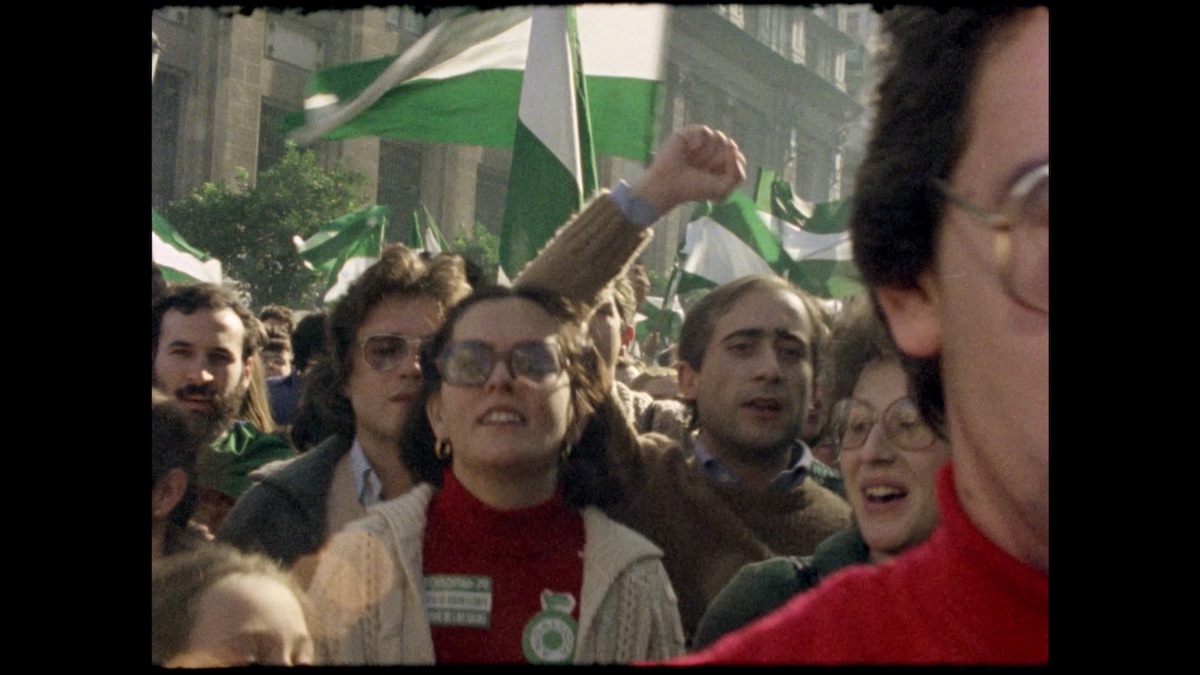
On Septimbre arrives at Spanish cinemas one of the most fascinating films of the year. It's about Resistance boxa documentary that goes far beyond conventional cinema since it constitutes an act of poetic justice. Resistance box Recover the figure of a Sevillian filmmaker, Fernando Ruiz Vergara, author of the documentary Dewwhich was the first judicially censored film in Spain after the approval of the 1978 Constitution. That is, censorship did not end with Franco, but persisted for a while. Ruiz Vergara made a documentary film about the Rocío party, about the town of Almonte and La Pilgía, and could not release his film. He self -exiled to Portugal after this censorship and died in 2011 leaving dozens of films of films he could never perform. Now, thanks to the filmmakers Concha Barquero and Alejandro Alvarado these projects dreamed by Fernando come alive.
CONCHA: The issue is that this documentary, DewIn principle, it was a kind of deconstruction of the pilgrimage. It was an anthropological, political and historical film. But, among the various issues he addressed, introduced the democratic memory, the question of the reprisals and killed in the summer of 36 by the Francoist rebels. Of course, it was a very thorny issue, even more in those years, because the film premiered in 1980 and filmed in 77 and 78. So you can imagine how bold it had to be to raise something like that in those years. That made it, in some way, a cursed filmmaker, because the film, although at the beginning of his life a very short tour, was quickly kidnapped and judicially censored. Fernando failed to make any more movie, and Resistance box Try to claim that Fernando and his cinema – even the one who did not get to do – are much more than cinema; They are powerful cinema and, as you mentioned before, fascinating.
Resistance boxas we said, it is a fabulation about those dream projects that Fernando did not make, carried out from the present. As the title indicates, it is a gesture of resistance that implies appropriating the work of another filmmaker and taking it to your land.

ALEJANDRO: Indeed, we linked ourselves because we met Fernando in his last year of life, being conducting an academic research – the UMA professors – about the censorship of the transition documentaries. We had a tremendous affinity with him. In Andalusia we do not have many filmmakers and he proposed to help him in a last project that finally was not done: it was one of the sequences of our film, about the Wolframium mine near where he lived in Portugal. When he died, unfortunately we thought we should continue with that work that had linked us intensely during that year and that the best way was, thanks to his Portuguese friends who had scanned all their notes, scripts and sketches, continue their work.
It seemed to us that the films that contained those unrealized scripts offered much to tell. We wanted to do so: reinterpret them. We did not want to make a film based literally on the scripts, but a reinterpretation, because we understood that there were current issues of the present in our countries, Portugal and Spain, since the film travels through both territories.
This is an Iberian film that values that joint production between Spain and Portugal. In fact, the Portuguese documentary cinema has a filmography that details historical processes such as the carnation revolution, something that in Spain was reflected more shy. At a time when there is so much talk about historical memory, why do you consider, as researchers, that we do not have a cinematographic legacy similar to the Portuguese in that sense?

CONCHA: I think that all this is parallel or reflecting how transitions have occurred. In short, they had a revolution. But I think our offer and our cultural and cinematographic creation have a lot to do with the country's political and social drifts. In Spain there have been numerous recovery documentaries of historical memory, especially in the early 2000s, with the mobilization and opening of graves. It was a more level oriented to the recovery of what was done. We consider that it is necessary to consider not only what to tell – because there is still much to narrate and to do, as Fernando said, in terms of repair and justice for the victims – but also how the cinematographic form can be an ideal field for reflection.
For us, this film is a hybrid documentary, where there are elements, not exactly fiction, but of imagination and fantasy. We think that imagining possible worlds has a lot to do with that vital company in Fernando, with its creative, political and vital utopia.
The documentary has had an excellent reception at festivals, winning an award in South Korea.
ALEJANDRO: That's how it is. It has been very well in the festivals circuit, and precisely a film as handmade as ours, in which we have been working and investigating for more than fifteen years, required its time. The past fall was very satisfactory, because we participated in many Spanish festivals and, in addition, we had an international premiere at a very prestigious festival for films of this type. We have taken prizes and believe that this will help the public come to the cinema and accompany us in the Albéniz.
What a luxury to have Concha Barquero and Alejandro Alvarado, two Malaga filmmakers at the University of Malaga. A perfect tandem within the Spanish documentary cinema made from Malaga. Thank you very much and good luck.
Source: https://cineenserio.com/entrevista-a-concha-barquero-y-alejandro-alvarado-directores-de-caja-de-resistencia/