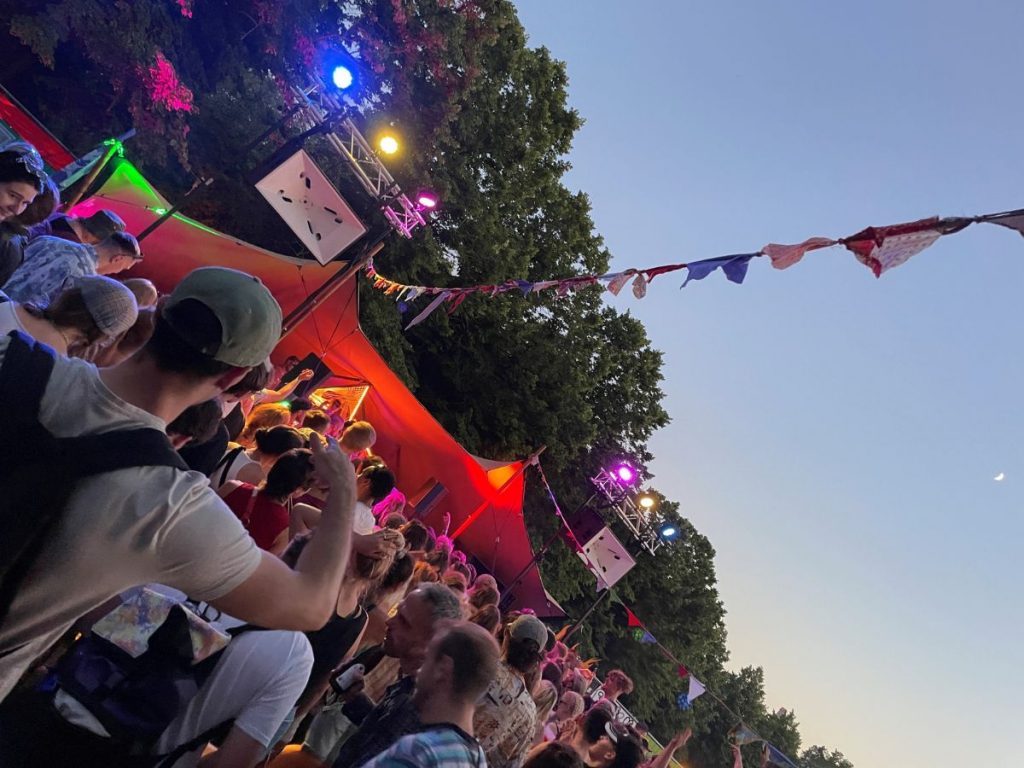
Rhythmic bass in your ear, the evening summer sun on your skin, a cool drink in your hand. The set has reached its climax, the dance floor is full – and then: it's over. It's 10 p.m. The open space concept for legal open airs has been shaping the Leipzig rave scene for almost four years. There are mostly mixed feelings there.
The concept was eagerly awaited at the time: “Legalization of spontaneous parties exceeds all expectations,” was the headline in the LVZ in May 2022 about the new low-threshold application process for non-commercial open-air cultural events. The concept was launched on June 2, 2022. In fact, the officially approved celebration offer was groundbreaking at the time – and the excitement was correspondingly great. This year marks the fifth season; Time for a summary. What happened to the exceeded expectations? In some cases they have given way to resignation and a sobering standstill. Others, however, see the concept as a clear enrichment of the scene. The hard facts at least speak for themselves: a total of 84 events have been held on the eleven approved areas in the last three years.
Nils Fischer, special representative for night culture for the city of Leipzig (#nottheNachtbuergermeister), spoke in an interview with gladfroh, among other things, about the process that makes legal rave locations in Leipzig possible. It is a process that began in 2015 – initiated by collectives and creatives from the scene. After years of exchange with local politicians and administration, a cross-party resolution was finally passed in the city council in 2021, which was intended to renew the previously opaque process. “Theoretically, you could have applied for an open air event on any green area in the city back then. But it was a very non-transparent approval process,” says Fischer. The plan was to have unbureaucratic approval procedures that would clearly define the limits of what was possible, he adds. A clear success, because the organizers are also satisfied with the new, uncomplicated application process. “It’s actually relatively easy, similar to reporting a meeting – i.e. a demonstration,” members of the Lpzg.Callin collective describe the application process via the city’s website. It was the first collective to use the new concept in 2022. Even before the introduction, they organized an open air event marked as a political event in April 2022 together with the Green politician Jürgen Kasek.
Another reason for the new concept was to create a certain level of planning security for the organizers, Nils Fischer tells us. On the one hand, there were very high emission forecasts that were hardly financially manageable for the collectives. Added to this was the fact that illegal parties can be broken up by the authorities at any time. The city was aware from the start that the new concept could not remove parts of the scene from illegality – but they wanted to offer everyone an alternative to this, Fischer continued.
Not a zero-sum game
And does this work with planning security? It seems as if this goal remained more of a project and not part of reality. Thanks to the open space concept, organizers no longer have to expect their open airs to be spontaneously dissolved, but the legalized events also pose a financial risk. According to the open space concept, no entry fees, mandatory donations or other usage fees may be charged for participation in the event.
Only the “distribution of food and drinks in return for a donation to cover expenses” is permitted, according to the city’s website. A sometimes negligent planning and communication with and between the authorities, strict requirements regarding the toilets – two Dixis are needed per 100 visitors, which cost around 300 euros – as well as high expenses for waste disposal and equipment are further reasons for the risk. Not to mention the time required. Resonant eV tells us that these are all hurdles that can hardly be overcome without cultural support
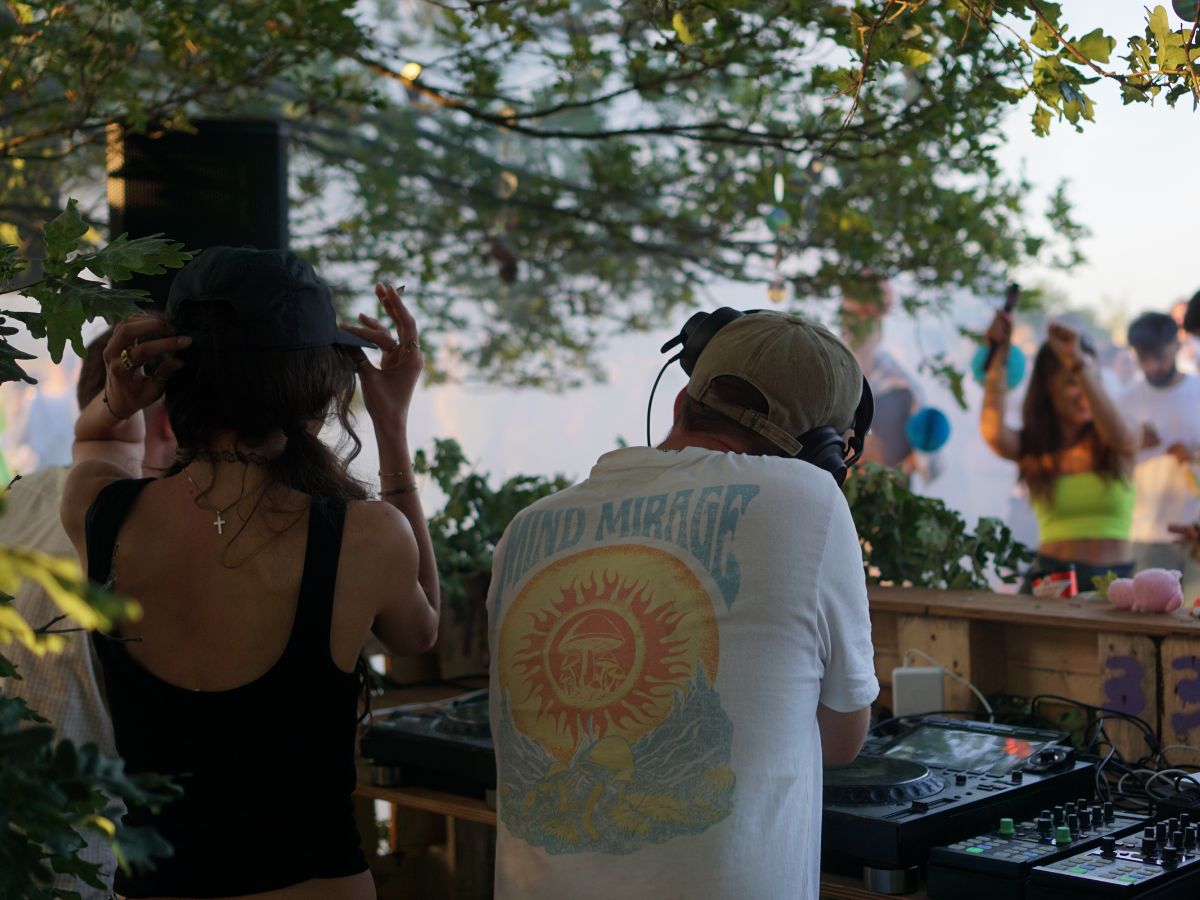
The event and music collective from Jena and Leipzig has so far organized three public open airs with the new concept, including at the Neue Messe and in Mariannenpark. “We simply tried to register it – and it worked,” members of the collective tell us. But the biggest sticking point, according to Resonant, is the approved time frame for legal open airs: you can celebrate until 10 p.m., with a special permit until 11 p.m. However, it would make more sense for organizers and visitors if events were allowed into the night, the Resonant members tell us. Because there are usually only a few guests at the open airs during the day – especially in the early hours of the day – who could support the collectives financially with their drink purchases or donations. They tell us that, as is typical for the scene, they tend to come in the evening.
Their verdict: “We believe that this concept has never been particularly attractive for most collectives, clubs and subcultural actors. And the main reason is the time of day.” An example from Mariannen Park shows that communication between offices and collectives sometimes does not work smoothly. In the summer of 2023, Resonant eV registered its second open air there. At first everything went smoothly: noise protection plan approved, system ordered, construction planned.
Two days before the event, the collective checked the area again. What they find: around 15 beehives – exactly where the facility should be according to the protection plan. A clerk simply assumed that the area of the park was wrong. They contacted the beekeeper at short notice. Construction fences were borrowed and covered with advertising banners to shield the bees' flight direction from the public. Cost: 150 euros – which no one will reimburse. A zero number for Resonant interpersonally, they comment dryly. The open air took place, but there were still bee stings – at least once by every member of the construction team, according to their own statement.
A different audience
Nevertheless, it would be wrong to just talk about resignation. Both collectives are happy about the diverse audience, who get an insight into the rave scene thanks to the easy accessibility of the events. Because not everyone can afford the sleep deprivation on weekends that is typical of the scene or the increased entry and drink prices in clubs – the concept is a clear enrichment for them. Despite the criticism and the financial risk, Lpzg.Callin gets to the point:
“The benefit from more audiences and low thresholds outweighs the financial risk.”
Nils Fischer has also noticed pensioners tapping along and many children wearing funny earmuffs at the open airs – people you wouldn't find in the club. The special representative for night culture himself seems proud of what the concept has created. Perhaps this is also the real strength of the open space concept: the scene is not only conveyed in terms of legality, but is simply opened up to a wider audience.
The new trade fair as an anchor of hope
For the rest of the club scene, however, the problem with the time remains. The location on Neue Messe / Alte Dübener Straße could actually have been what the scene has been longing for so far – an open-air location for the night. Far away from residential areas, close to the motorway and in the middle of the flight path of Leipzig/Halle Airport – who should be disturbed here?
Two test events were organized there in the summer of 2024. With success, because no one complained, says Fischer. Last year there were two events on Alte Dübener Straße. However, the noise forecasts in the nearest residential area were exceeded. What had to happen followed: the first complaints from residents about a rave at the Neue Messe. At a drum'n'bass party, the bass was probably too strong and the weather conditions were possibly unfavorable, so that, according to Nils Fischer, the sound reached a longer distance to the nearest residential area. A circumstance that could initially disqualify the Neue Messe location for further nights.
Fischer confirms to us that this year they will test whether celebrations can last until midnight – but the city no longer plans to use the site completely at night. The organizers react to this with disappointment: “That’s annoying because there was a great desire to be able to continue having the parties at night – even before these open spaces existed,” say the members of the Lpzg.Callin collective. And Resonant eV expresses its frustration as follows: “We were really looking forward to it and had a really great event, which went very positively during the night. And we actually met all the measurements – but there were still complaints.”
What remains?
Four years after the introduction of the open space concept, the results are as contradictory as beehives next to subwoofers. 84 events in three seasons sounds like a lot. In addition to the theoretical 52 possible events on all weekends between the beginning of March and the end of October, this is only a occupancy rate of less than 60 percent. And yet ten applications for events were rejected in 2025 because no suitable time was available in coordination with the city, says Nils Fischer. On the other hand, there is easier accessibility for a diverse audience who may otherwise not have access to the scene.
It still appears that the concept scratches the broad boundaries of what is possible without being able to expand them. The basic problem is still the tight time frame. The location at the Neue Messe was the only attempt to change this so far and has now been partially canceled again after two seasons.
The fact that the concept still exists and is even considered a model for other approval procedures, as Fischer emphasizes, is part of the ambivalence, as is the justified criticism and resignation of the organizers. Resonant eV therefore does not want to organize an event this year as part of the open space concept. “In the end, it’s just not worth the effort and risk,” its members tell us.
Lpzg.Callin remains hopeful for the next season. Her feeling is that a rethink is slowly taking place in the scene – away from purely night-time programming and towards a broader, lower-threshold offering. “Just go party in the park on Saturday lunchtime – and then go to the club again at ten or eleven,” says the collective. Whether this is a real cultural shift or just an adjustment to what is currently possible remains to be seen. The Leipzig open space concept remains ambitious enough to offer an alternative, but not yet sufficiently extensive to capture the entire scene.
How to: Open Airs in Leipzig – an information event
Do you want to organize an open air event yourself on the legal areas of the city of Leipzig? On April 15, 2026, the Leipzig Night Council is offering an information event in the Münze's Café-Bar Drei. From 6 p.m. an employee from the Leipzig Office for Urban Greenery will answer your questions. There is no need to register, just come.
Source: https://www.frohfroh.de/45729/um-zehn-ist-schluss-wie-es-um-das-konzept-fuer-legale-open-airs-steht