
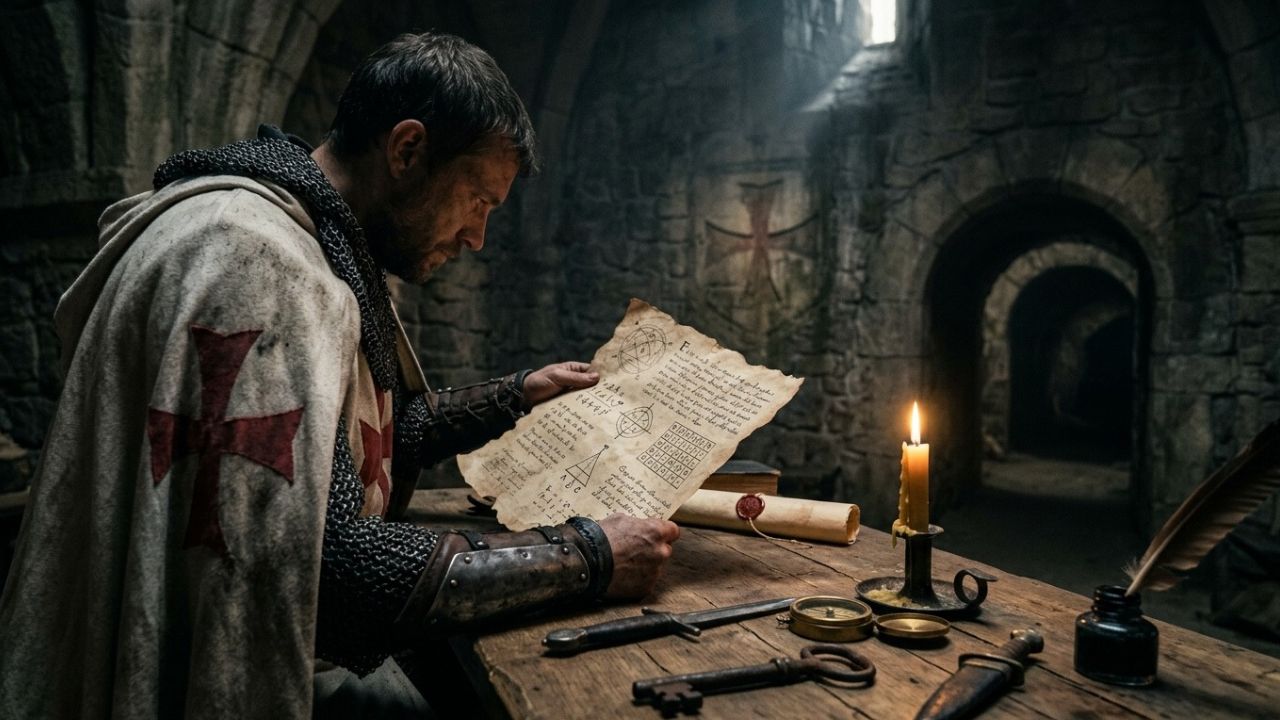
Few organizations in medieval history have inspired as many legends, conspiracy theories, and historical investigations as the Knights Templar. Founded in the early 12th century, this religious military order became one of the most influential institutions of the Crusader era. Its members protected Christian pilgrims traveling to the Holy Land, fought in military campaigns, managed valuable properties, and developed a financial network that reached across much of Europe and the eastern Mediterranean.
Yet the Templars left behind more than castles, battlefields, and religious traditions. Their distinctive symbols, strict rules, secretive ceremonies, and sudden destruction have fueled centuries of speculation about hidden knowledge and an alleged secret code.
Did the Knights Templar possess a secret language? Were their symbols designed to communicate messages that outsiders could not understand? Did they protect ancient religious knowledge, or were their mysteries largely the product of secrecy, political conflict, and later storytelling?
The answers require separating documented history from legend. Although there is no conclusive evidence of a universal Templar cipher containing forbidden knowledge, the order’s historical practices provide fascinating clues about medieval communication, religious symbolism, and the power of secrecy.
📜 The Origins of the Knights Templar
The story begins around 1119, when a small group of knights established a religious brotherhood in Jerusalem, following the First Crusade and the creation of several Crusader states in the eastern Mediterranean.
Traditionally associated with Hugh of Payns, a knight from the Champagne region of France, the brotherhood aimed to protect Christian pilgrims traveling through dangerous territories. Its members combined the religious commitments of monastic life with the military responsibilities of armed knights.
The order received official support at the Council of Troyes in 1129, helping establish its religious legitimacy and organizational structure. Bernard of Clairvaux, an influential Cistercian abbot, became an important advocate for the Templars and defended the concept of a religious warrior dedicated to Christian service.
The order eventually became known as the Poor Fellow-Soldiers of Christ and of the Temple of Solomon. Its name reflected its headquarters in Jerusalem, traditionally associated with the site of the ancient Jewish Temple.
Despite the image of poverty suggested by its name, the organization gradually accumulated substantial wealth. Donations from European nobles, landowners, and monarchs supported its military operations, while its estates generated income to finance activities in the Holy Land.
The Templars developed a sophisticated administrative system that connected communities across different kingdoms. Their organization relied on written documents, official seals, internal regulations, and established procedures. These practices were essential to maintaining discipline and coordinating activities over long distances.
The combination of military power, religious authority, wealth, and restricted internal knowledge would eventually contribute to the legends surrounding their supposed secret code.
🔑 What Was the Templar Secret Code?
The expression “secret code of the Knights Templar” can refer to several different things. Some interpretations involve encrypted messages, while others focus on symbols, rituals, organizational passwords, and alleged hidden teachings.
Historically, it is important to distinguish between a code in the modern cryptographic sense and a symbolic system used by a religious organization.
A cipher transforms information according to a rule so that someone without the key cannot easily understand it. A symbol, by contrast, can communicate an idea without concealing a literal message. A ritual password may establish identity or membership without encoding a longer text.
The Templars operated in a world where literacy was unevenly distributed, communication was slow, and official documents required methods of authentication. Seals, formal titles, written instructions, and restricted organizational procedures helped protect authority and distinguish legitimate orders from fraudulent ones.
However, surviving historical evidence has not established that the Templars possessed one universal cipher capable of revealing a hidden doctrine, a lost treasure map, or a secret account of sacred history.
Their actual secrecy was more practical and institutional than many modern legends suggest. As a disciplined religious and military order, they had reasons to restrict access to internal affairs, protect administrative information, and regulate the conduct of their members.
Over time, these ordinary features of medieval institutional life became the foundation for much more extraordinary claims.
🛡️ The Two Knights on One Horse: A Symbol of Brotherhood
One of the most recognizable images associated with the Templars is a seal depicting two mounted knights sharing a single horse.
<text>At first glance, the image seems to represent poverty. The knights’ early commitment to a humble way of life has led many historians and interpreters to associate the design with their original ideals of simplicity and brotherhood.</text>
The seal is also a reminder that medieval symbols could communicate multiple meanings. A single image might express religious values, institutional identity, political legitimacy, and a group’s understanding of its own history.
The two riders have sometimes been interpreted as evidence of hidden teachings or coded references to duality. Such interpretations are intriguing, but they should not be confused with established historical conclusions.
The most cautious explanation connects the image with the order’s identity and early ideals. Claims that it encodes a secret doctrine require evidence beyond the symbol itself.
Nevertheless, the image illustrates why the Templars remain so fascinating. Their surviving visual culture offers clues about how they presented themselves to the outside world, while leaving room for questions about how their members understood their own symbols.
✝️ The Red Cross and the Language of Faith
The red cross is another defining feature of the Knights Templar. The order became associated with a distinctive red cross worn on white clothing, a combination that communicated religious commitment and military identity.
In medieval Christianity, the cross represented the sacrifice of Jesus Christ and the promise of salvation. For the Templars, wearing it also distinguished them as members of a religious order engaged in armed service.
The cross was therefore a public sign rather than necessarily a secret code. Its meaning depended on shared religious beliefs, social conventions, and the authority of the institution that displayed it.
Modern interpretations sometimes connect Templar crosses to hidden geometric systems, ancient civilizations, or esoteric traditions. Such theories are part of the order’s popular mythology, but there is no solid historical basis for treating every cross associated with the Templars as evidence of concealed scientific or supernatural knowledge.
The broader lesson is that symbols can be powerful without being cryptographic. A recognizable emblem can unite members, intimidate opponents, inspire supporters, and preserve institutional identity across generations.
🏛️ Seals, Documents, and the Mechanics of Medieval Secrecy
While dramatic legends often emphasize mysterious inscriptions and underground chambers, some of the most revealing evidence about Templar communication comes from ordinary administrative practices.
The order maintained properties, received donations, managed financial arrangements, and coordinated personnel across extensive territories. Such responsibilities required reliable records and ways to verify authority.
Seals were particularly important. In medieval Europe, a seal attached to a document could help establish its authenticity and identify the person or institution responsible for issuing it. A forged seal could undermine a transaction or create serious political problems.
Written correspondence also mattered. Messages traveling between distant commanderies could take weeks or months to arrive, depending on weather, routes, and political conditions. Administrators needed methods to preserve information, confirm instructions, and maintain continuity when officials changed.
The Templars were not alone in these practices. Monasteries, royal courts, merchant networks, and other military orders also used documentary systems to protect their interests.
Even so, the combination of extensive resources and a hierarchical structure made the Templars particularly prominent. Their administrative expertise contributed to the impression that they possessed extraordinary knowledge unavailable to ordinary people.
Their financial operations, in particular, later attracted considerable attention. The order could receive valuables, transfer funds through established arrangements, and provide services that helped travelers avoid carrying large amounts of money over dangerous routes. These activities were sophisticated for their time, but they do not demonstrate the existence of a supernatural or all-encompassing secret code.
🕯️ Initiation Rituals and the Power of Restricted Knowledge
Membership in the Knights Templar was not open to everyone. Candidates had to undergo a formal admission process and accept the order’s religious obligations, discipline, and rules.
As with many medieval religious institutions, initiation ceremonies reinforced the distinction between members and outsiders. Oaths, formal questions, prescribed gestures, and ceremonial language helped establish commitment and loyalty.
The precise details of Templar initiation have become especially controversial because accusations made during the order’s persecution described alleged secret practices and religious offenses.
When King Philip IV of France moved against the Templars in 1307, members were arrested and interrogated. Some confessed to misconduct, including alleged abuses during initiation. However, many confessions were obtained under torture or intense coercion, and the reliability of these accusations remains a central problem for historians.
The charges included claims that Templars denied Christ, mistreated the cross, or engaged in forbidden rituals. These allegations became important evidence in the campaign against the order, but they cannot simply be accepted as objective descriptions of normal Templar life.
Secrecy made the accusations easier to spread. Because outsiders could not independently observe every internal ceremony, allegations about initiation could be presented as revelations of hidden wrongdoing.
This does not prove that the order had no confidential rituals. It demonstrates that claims about those rituals must be evaluated in light of the political circumstances and the methods used to obtain testimony.
🗝️ The Lost Treasure and the Mystery of Hidden Knowledge
Few stories about the Knights Templar have proved more persistent than the idea that they discovered or protected a priceless secret in Jerusalem.
Popular accounts have connected the order to the Ark of the Covenant, the Holy Grail, ancient manuscripts, hidden royal genealogies, and treasures supposedly concealed beneath the Temple Mount.
These narratives often begin with a historical fact and then extend far beyond the available evidence. The Templars were based in Jerusalem during a period of extraordinary religious and political significance. Their headquarters were associated with the site traditionally linked to Solomon’s Temple. Their wealth, discipline, and restricted internal life naturally encouraged speculation about what they might have encountered.
Yet no reliable historical evidence establishes that the Templars discovered the Ark of the Covenant, possessed the Holy Grail, or uncovered a secret body of knowledge capable of transforming world history.
The Holy Grail itself belongs to a complex tradition of medieval literature whose meanings evolved across different texts and periods. Its later association with the Templars owes much to storytelling and modern reinterpretation rather than conclusive contemporary documentation.
Treasure stories also gained strength from the order’s sudden suppression. When an organization disappears, its property is confiscated, and its records become scattered, unanswered questions can easily turn into legends.
The possibility that individual Templar assets or documents were lost is entirely plausible. The claim that a single extraordinary treasure explains the order’s rise and fall is much harder to substantiate.
⚖️ 1307: The Arrests That Changed Everything
On October 13, 1307, King Philip IV of France ordered the arrest of numerous Templars within his kingdom. The operation was coordinated and dramatic, targeting an organization that had enjoyed decades of religious prestige and considerable economic influence.
Philip faced serious financial pressures and sought to strengthen royal authority. The Templars’ wealth, independence, and international connections made them a powerful institution, even though the precise motivations behind the crackdown remain the subject of historical debate.
The arrested knights were accused of heresy, sacrilege, and other offenses. Under interrogation, some made confessions that supported the charges, while others resisted or later withdrew their statements.
Pope Clement V became involved as the controversy expanded beyond France. The proceedings exposed tensions between royal power, ecclesiastical authority, and the rights of a religious military order.
In 1312, the pope formally suppressed the Templars through the papal bull Vox in excelso. Two years later, Jacques de Molay, the order’s last grand master, was executed in Paris.
The order’s dissolution created a historical vacuum that legends would eventually fill. If the Templars had hidden knowledge, where had it gone? If they had accumulated extraordinary treasure, who had inherited it? If their leaders had been condemned unjustly, what truths had been silenced?
These questions became the raw material for centuries of speculation.
🔥 From Historical Order to Secret Society Legend
The modern image of the Knights Templar developed through a long process of reinterpretation. Medieval chronicles, later religious controversies, romantic literature, and fraternal traditions each contributed to the order’s changing reputation.
During the 18th and 19th centuries, some fraternal organizations incorporated Templar names, imagery, and ceremonial themes into their own traditions. These later groups helped popularize the idea that Templar knowledge had survived through an uninterrupted chain of secret transmission.
However, the historical connection between the medieval military order and modern organizations using Templar symbolism is not the same as proof of continuous institutional survival.
The same distinction applies to claims involving Freemasonry, secret political networks, and esoteric schools. Shared symbols and later legends can establish cultural influence, but they do not independently prove that medieval secrets were preserved unchanged for centuries.
The Templars’ story became especially attractive to writers seeking hidden histories. A powerful order destroyed under suspicious circumstances offered an ideal setting for narratives about forbidden truths, concealed manuscripts, and secret guardians.
In fiction, almost any mysterious artifact can become a Templar relic. In historical research, however, a convincing claim requires identifiable documents, reliable dating, credible provenance, and independent corroboration.
🧩 Could the Templars Have Used Real Ciphers?
The question of whether individual Templars used encrypted messages deserves a more careful answer than either complete dismissal or extravagant speculation.
Medieval societies were familiar with methods of concealing information, including coded language, substituted letters, obscure abbreviations, and restricted forms of communication. Military and diplomatic circumstances sometimes created a practical need to protect sensitive messages.
It is therefore possible that Templar officials used particular techniques to safeguard information in specific circumstances. The existence of such practices would not be surprising in a large organization operating across politically unstable territories.
However, the historical record does not establish a single, standardized Templar cipher that explains the order’s major mysteries. Nor does it demonstrate that their symbols contain a consistent hidden message waiting to be decoded.
A proposed cipher must do more than produce an interesting interpretation. Researchers need to identify the original inscription or document, establish its date and context, explain the decoding method, and show that the method works consistently rather than only on selected words.
Without these safeguards, almost any collection of letters, numbers, or symbols can be made to appear meaningful through selective interpretation.
The most productive approach is to examine each alleged Templar code individually. Some claims may reflect genuine medieval communication practices, while others may originate in much later legends or modern inventions.
🌍 Why the Templar Mystery Still Matters
The fascination with the Knights Templar extends beyond the possibility of hidden treasure or secret messages. Their history raises enduring questions about the relationship between knowledge, authority, religion, and political power.
The order operated at the intersection of military service, religious devotion, property ownership, and international administration. Its members were expected to obey strict rules while participating in a world shaped by warfare and competition among rulers.
Their rise demonstrated how a relatively small brotherhood could develop into an institution with far-reaching influence. Their destruction revealed how vulnerable even a powerful organization could become when it lost political protection.
The secrecy surrounding their internal affairs helped preserve group identity, but it also made the order an attractive target for accusations and speculation. Once the Templars disappeared as an institution, the absence of definitive answers allowed later generations to imagine what the historical record could not confirm.
Today, historians continue to study the order through surviving charters, papal records, legal proceedings, archaeological evidence, and material remains. This work provides a more nuanced picture than either the romantic image of flawless warrior monks or the sensational portrayal of a sinister secret society.
The real history is complex enough to deserve attention without requiring every legend to be true.
🔎 The Final Clue: History or Myth?
The secret code of the Knights Templar remains one of the most compelling mysteries associated with medieval Europe, but its meaning depends on what the phrase is intended to describe.
If it refers to symbols, seals, initiation ceremonies, restricted information, and the internal rules of a religious military organization, then the Templars certainly possessed forms of communication and institutional knowledge that outsiders did not always share.
If it refers to a single master cipher concealing the Holy Grail, an ancient supercivilization, or a forbidden truth capable of rewriting history, the available evidence does not support that conclusion.
The distinction is important. Historical investigation does not eliminate mystery. It identifies which questions can be answered, which interpretations remain plausible, and which claims exceed the evidence.
The Knights Templar left behind a remarkable legacy of religious symbolism, military organization, administrative innovation, and political controversy. Their story demonstrates how secrecy can become a source of both power and vulnerability, especially when an institution is destroyed before its history can be fully understood.
Perhaps the most enduring secret of the Templars is not a hidden code at all. It is the way a real medieval organization became transformed into a legend, with every unanswered question opening the door to another interpretation.
Centuries after their downfall, the Templars continue to challenge historians, inspire storytellers, and captivate readers. Their symbols remain recognizable, their destruction remains controversial, and their supposed secrets continue to attract attention.
The evidence may never confirm every legend. But the search for the truth behind the order offers something more valuable than a fictional treasure map: a glimpse into the medieval world, where faith, power, money, and mystery were often inseparable.