
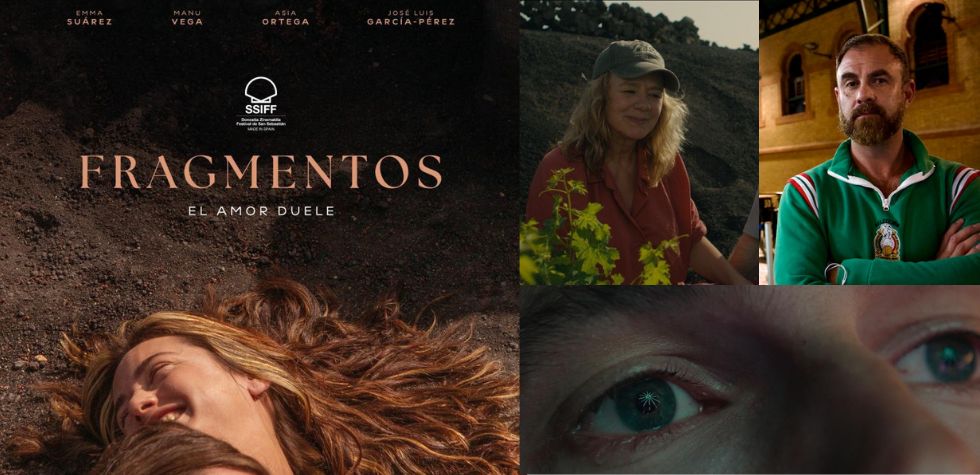
In full promotional tour of Fragmentswe met with the director of Mexican origin Horacio Alcalá to talk about love, heartbreak and the cracks in relationships that go through his film. A few hours after its premiere in cinemas throughout Spain, this December 12, the filmmaker breaks down how Lanzarote becomes another character and how the silences, reproaches and daily discomfort configure the emotional landscape of its protagonists.
Fragments It starts from an idea by Frank Ariza, on which you begin to work. You are a director of Mexican origin, residing in Madrid, who is going to film in Lanzarote. How did this whole trip come about?
I was visiting friends in Mexico when I got the script. When reading it, I felt that many of those phrases I had said or had been told to me, because in these situations there are no executioners or punishers. Then I started to imagine the story in Lanzarote. I know the island very well because I spend a lot of time there, so I was already assigning which scenes could go in which locations. When I presented it to Frank and Manu Vega, who in addition to being an actor is a producer, they liked the idea.
So it wasn't planned in the script for the story to take place in Lanzarote?
There was a situation raised, but not a specific location. At first, in the first meeting, there was talk of doing it in the Sierra de Madrid or somewhere in the woods where the couple could go on vacation, a place to rest, but there was no final decision. For me, in the end, the island becomes a character. I felt that the protagonists, first of all, had to be walking on lava. That was the main reason for taking the story to Lanzarote. The second thing is that, being on an island, it is very difficult for the characters to escape from each other: since it is so small, they are forced to find each other, and there are also very few places where they can hide. They can only take refuge in the house or in the bar; the rest of the time they are outdoors.
I wanted the characters to be unprotected. There are many shots in which you see them cornered, in a corner of the frame, and the rest of the image is the island, because the island has to be present as a character. I wanted to give it prominence through the images. There are moments in which we know that the characters wake up, but what we see is the island waking up, and a kind of vibration is generated throughout the film that is, in reality, the earth vibrating.

The film is spoken of as a reflection of contemporary love. I would say that it is actually a reflection of love in general.
The thing is, I don't believe there is something called “contemporary love”; Love has been the same for millions of years, from when we were monkeys to what we become. Love has not changed nor will it change. It is one thing for us to evolve physically, but emotionally that does not transform as much. We can talk about the type of love that these characters experience, very specific in the film, but we cannot talk about a universal love. For these characters, in that place, love hurts.
Furthermore, in the film each character has their own idea of what love should be. For Diego, love is that Alba belongs to him; For Alba, love is being left alone; and for the other couple, love is being comfortable. There is a moment in which Diego says: “Alba loves me badly. She loves me, but she loves me badly. She doesn't know how to love me.” But, in reality, who knows how to love? I think there is a question of blindness there: being blind to the situations you are experiencing, when you do not know how to react or, even more so, when you do not know how to say no to a situation. That's where you expose yourself to becoming anything.
Fragments It places two characters at a point where they are on the verge of breaking up, and precisely what is investigated during the story is the mystery of whether that breaking up will finally take place. Why were you interested in this idea of heartbreak?
I was interested in the idea of heartbreak because they are things that I have experienced and that I have seen many people live. Now, when we do screenings with students, I always ask if anyone has gone through something similar and, although we are talking about young people between 18 and 25 years old, 90% raise their hand. We are destined to go through these types of situations.
There is a moment in the film, when the four characters sit down to share a meal, which structures the story where the title of Fragments. I think the film takes a fragment of each of our characters' lives and places it on a table; The island puts those fragments in front of them and they begin to reflect, but they are broken pieces. We don't know anything about the lives of these characters before, we don't know their families; The only thing we care about is how they are when they get there.
I wanted the characters to be unprotected; That is why the island of Lanzarote is almost another character, the earth that vibrates under your feet.
Horacio Alcalá, director of “Fragments”
Were you afraid, while making the film, that one of the characters would end up as “the bad guy” in the story?
Let's see, Asia Ortega's character could perhaps fall into that, but we have been very careful when it comes to giving her moments of light, almost of brilliance, at the end, to understand why she is like that. I want to think that in this film there are no good or bad characters; There are characters who are victims of their past or of a situation that they do not know how to control.
In the film there are two couples: one formed by Emma Suárez and José Luis García Pérez, two actors with a long career in Spain, and another by Manu Vega and Asia Ortega, two younger performers. How did you work on those differences in route and experience?
We have worked on the characters individually with each one. The first thing we did, before even getting into character, was tell ourselves our own love stories, the situations we have gone through. That, of course, gave us a lot of language and material to later build each role. We actually only did a dress rehearsal when we got to the island, for the food sequence. The rest was all individual work. There were three weeks of filming and one of those weeks was practically dedicated to food, which is the backbone of the story.

At the beginning in the script there were dialogues throughout the film, but when working with the actors themselves they told me: “I feel like my character here wouldn't say anything.” Then we removed the phrase. And then the other one told me: “I wouldn't say anything right now either,” and that's how those silences began to appear, because the characters asked for them. That complicity with them has been fundamental and, of course, I have learned a lot from the four of them. That's why I like the audience to identify not only with the phrases, but also with the actions, with the violence and with the way of keeping quiet, in that way of being uncomfortable with the other. I think that reflects much more how people can relate than the phrases themselves.
Source: https://cineenserio.com/entrevista-horacio-alcala-fragmentos/