
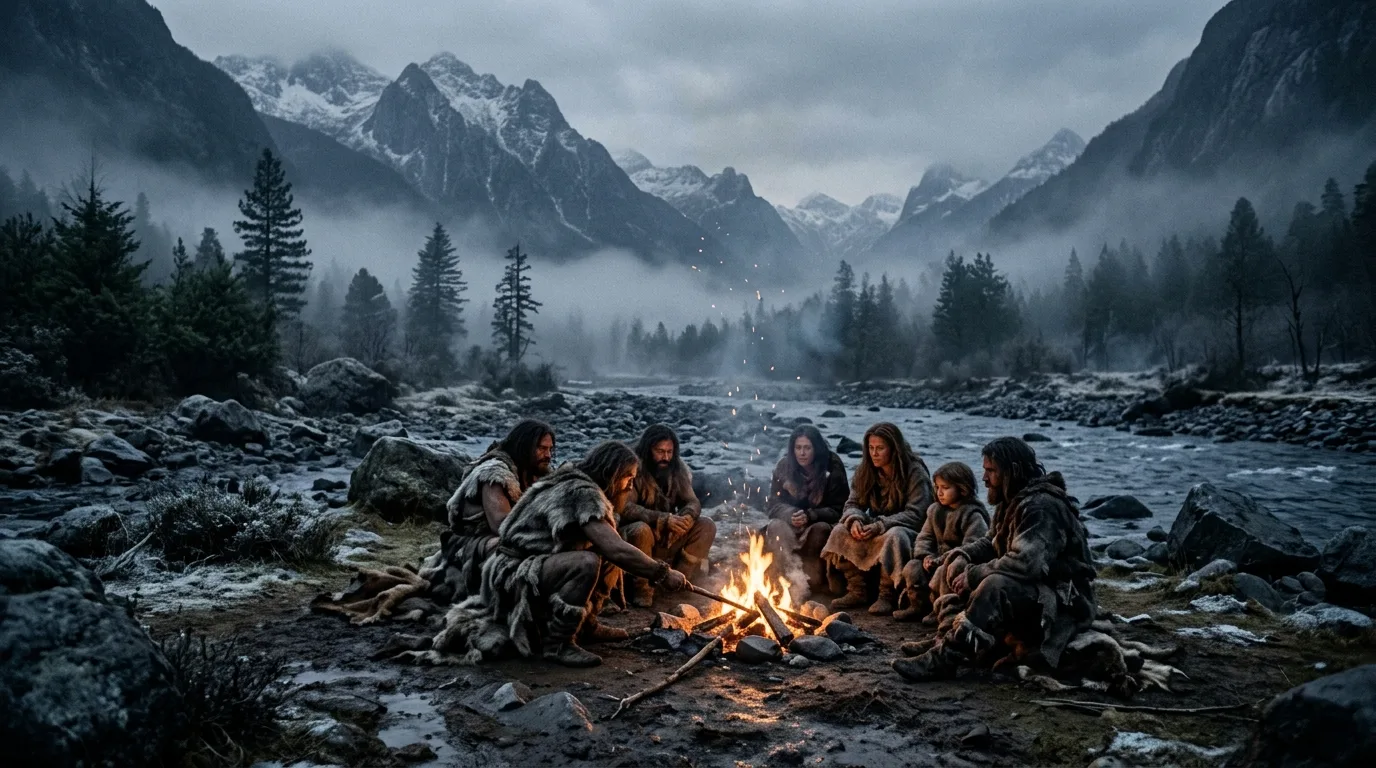
For all the modern confidence of an eight-billion-strong species that splits atoms, sequences genomes, and launches telescopes into deep space, humanity carries a surprisingly fragile pedigree. Beneath the triumphant arc of civilization lies an evolutionary record punctuated by dramatic shrinks, razor-thin margins, and moments when our lineage looked dangerously close to joining the fossilized dead ends of natural history.
Geneticists, paleoanthropologists, and historians do not always agree on every detail of these crises. In fact, some of the most famous near-extinction stories are fiercely debated in laboratories and excavation trenches. Yet taken together, these five moments illustrate how close ancient hominins and later human populations came to vanishing, and how sheer adaptability, migration, and luck kept the human story alive.
1. The Early-to-Middle Pleistocene Squeeze: Nearly Vanishing 900,000 Years Ago 🧊
Long before Homo sapiens walked the Earth, our direct ancestors faced what genomic researchers describe as one of the sharpest population collapses in hominin history. Between roughly 930,000 and 813,000 years ago, during the turbulent transition from the Early to the Middle Pleistocene, climate shifts pushed ecosystems into severe instability. Long glacial cycles intensified, aridification spread across Africa, and habitats shifted faster than many species could track.
A prominent genomic modeling study using the FitCoal method estimated that the number of breeding individuals among ancestral human populations plunged to roughly 1,280 people for more than 100,000 years. That figure is small enough to fit inside a single high school or a modest neighborhood today, yet for over a millennium of human generations, it represented the narrow bottleneck through which our lineage had to pass. Researchers have noted that this period coincides with a noticeable gap in the African and Eurasian hominin fossil record, suggesting how sparse ancient populations had become.
Not every geneticist accepts the exact numbers without question. Alternative analytical methods have sometimes failed to detect a squeeze of that magnitude, sparking spirited scientific debate over statistical inference versus ancient reality. Still, evolutionary biologists point out a fascinating paradox: small, isolated populations can sometimes undergo rapid evolutionary change, including chromosome fusion events and speciation dynamics that laid groundwork for later hominins. If our ancestors survived that deep freeze of fortune, they did so on a knife edge.
2. Mount Toba and the Volcanic Winter Debate: 74,000 Years Ago 🌋
Few near-extinction tales have captured the popular imagination quite like the Mount Toba supereruption on the island of Sumatra roughly 74,000 years ago. Ranking among the largest known volcanic eruptions of the last two million years, Toba blasted an estimated 2,800 cubic kilometers of material into the atmosphere, blanketing vast regions in ash and triggering fears of a prolonged volcanic winter.
For decades, the famous Toba catastrophe hypothesis argued that severe global cooling, acid rain, and ecological collapse crushed Homo sapiens down to just a few thousand or even 1,000 to 10,000 breeding individuals. According to that dramatic narrative, humanity survived only as scattered remnants clinging to life while ecosystems reeled.
Modern archaeology, however, has complicated and largely challenged the idea that Toba nearly wiped out our species. Excavations at sites such as Jwalapuram in southern India revealed stone tools both below and above Toba ash layers, showing remarkable continuity in toolmaking traditions. In northwest Ethiopia, researchers uncovered Toba glass shards alongside evidence that local populations adapted to drier conditions by fishing along seasonal pools and river corridors. Sediment cores from Lake Malawi likewise indicated less catastrophic East African cooling and vegetation collapse than early models once assumed.
Even if Toba did not single-handedly bring Homo sapiens to the brink of total extinction, the eruption remains a defining test of prehistoric resilience. Where ash choked landscapes and altered local environments, human groups with flexible foraging strategies, portable toolkits, and social networks found ways to endure.
3. The Out-of-Africa Founder Squeeze: Small Bands Crossing a Vast World 🌍
Even when a species is not facing a global catastrophe, the act of colonizing new continents creates its own perilous bottleneck. When groups of Homo sapiens migrated out of Africa and spread across Eurasia and eventually into the Americas tens of thousands of years ago, only relatively small subsets of the ancestral population made those journeys.
In population genetics, this is known as the founder effect. Because pioneering bands carried only a fraction of the genetic variation present back home, each wave of expansion narrowed the gene pool of the newly settled regions. That is a major reason why non-African human populations generally display lower overall genetic diversity than populations within Africa.
Life on the moving frontier was unforgiving. Small bands faced unfamiliar pathogens, harsh seasonal swings, large predators, and scarce food supplies without large backup communities nearby. If a single pioneering group succumbed to disease, harsh weather, or starvation, an entire regional branch could disappear before it ever established roots. What looks on a map like a steady march across continents was in reality a series of fragile gambles repeated by small bands of travelers.
4. The Last Glacial Maximum: Trapped in Ice-Age Refugia ❄️
Roughly 27,000 to 19,000 years ago, Earth reached the Last Glacial Maximum, when massive ice sheets covered huge swaths of northern Europe, North America, and Asia. Sea levels dropped dramatically as water remained locked in ice, while frigid winds and arid steppes turned once-habitable landscapes into unforgiving tundras.
For hunter-gatherers living in colder latitudes, survival meant retreating into ecological refugia, pockets of milder climate and sheltered valleys such as parts of the Iberian and Mediterranean regions. Population models of Europe during this interval show substantial contractions as cold expanded and habitable zones shrank. Studies of Ice Age populations have even pointed to periods when groups in challenging regions existed in remarkably small bands, sometimes numbering fewer than 30 individuals in local clusters, where low numbers raised risks of inbreeding, reduced fitness, and local extinction.
When a human band shrinks to a few dozen people, everyday misfortunes become existential threats. A bad winter, an injury to a skilled hunter, or a sudden drop in game can tip a tiny group from survival into collapse. The fact that humans not only endured the glacial peak but rebounded strongly as temperatures warmed underscores how vital mobility, cooperative sharing, and ecological knowledge were during the coldest chapters of recent prehistory.
5. The Second Plague Pandemic and the Black Death: Civilization’s Demographic Shock ☠️
Near-extinction is not purely a prehistoric story of stone tools and glaciers; dense settled societies have also faced devastating demographic shocks. Beginning around 1347, the second plague pandemic, driven by the bacterium Yersinia pestis, swept across Europe and neighboring regions before recurring in waves over more than three centuries.
Historians and geneticists estimate that mortality in many towns and villages during outbreaks ranged widely, commonly between 10% and 40%, with localized communities suffering far heavier losses. Trade routes, crowded urban centers, and maritime commerce that normally fueled prosperity suddenly accelerated contagion. Entire households were emptied, fields went untended, and some affected cities took generations, even into the seventeenth century, to recover their pre-plague population sizes.
While the Black Death did not threaten to erase Homo sapiens as a biological species, it struck hard enough to leave measurable signatures in human genomes and reshape social, economic, and medical history. Researchers studying ancient DNA from plague victims and survivors have found evidence of shifts in immune-related gene variants, illustrating how catastrophic infectious disease acts as a brutal evolutionary filter even in historical times.
Why Survival Was Never Guaranteed 📜
Looking across these five episodes, one lesson stands out clearly: human survival has rarely been a smooth, inevitable climb. Whether confronting Pleistocene climate swings, supereruptions, narrow migration bottlenecks, glacial cold, or deadly pandemics, humans endured through a mix of adaptability, social cooperation, and sheer chance.
Modern science, medical breakthroughs, and global agriculture give humanity tools our ancestors could scarcely imagine. Yet revisiting these close calls is a sobering reminder that resilience is forged under pressure, and that even a dominant species has history on its side only as long as it respects the fragility of the systems that sustain it.