
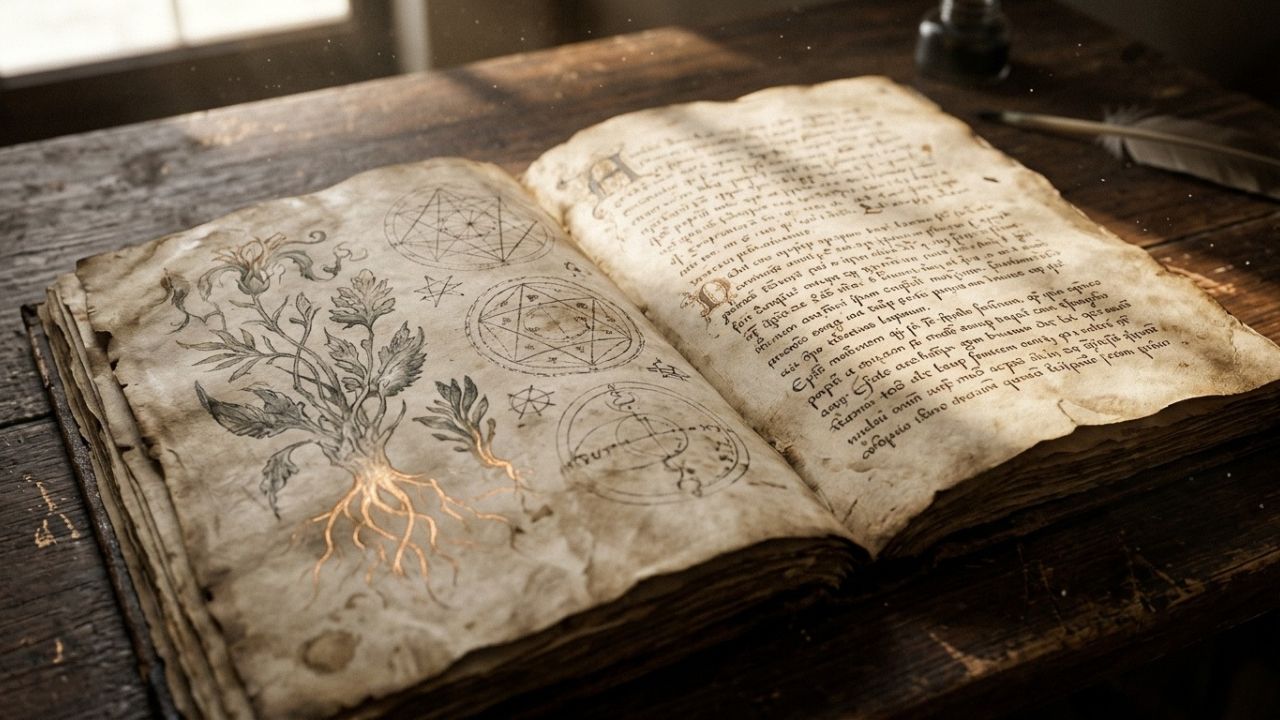
Deep within the austere and climate-controlled archives of Yale University’s Beinecke Rare Book and Manuscript Library rests an artifact that continues to mock the greatest intellects of human history. Cataloged quietly as Beinecke MS 408, it is universally known as the Voynich Manuscript. For over a century since its modern rediscovery, this compact, vellum-bound codex has stood as the Mount Everest of historical cryptography and linguistics. It is a book filled with intricate illustrations of bizarre plants, celestial diagrams, and bathing Nymphs, written entirely in a fluid, unknown alphabet that no living person can read.
The documented modern history of the manuscript began in the turbulent spring of 1912. Wilfrid Voynich, a Polish-American antique book dealer with a penchant for rescuing forgotten literary treasures, acquired the volume from the Jesuit college of Villa Mondragone near Frascati, Italy. The Jesuits were liquidating parts of their vast library holdings, and Voynich stumbled upon a codex that would consume the remainder of his life. He recognized immediately that he held something extraordinary. The pages were bound in calfskin, filled with hand-drawn illustrations using vibrant pigments of green, brown, blue, yellow, and red, and covered from margin to margin in a script that defied classification.
Yet, despite passing through the hands of elite cryptographers, World War II codebreakers, Harvard scholars, and advanced artificial intelligence models, the Voynich Manuscript remains stubbornly silent. It is an artifact that blurs the boundary between profound historical insight and an elaborate, centuries-old hoax. Every attempt to extract meaning has generated counter-arguments, leaving historians stranded in a permanent sea of ambiguity. To understand why this small book commands such fierce academic obsession, one must journey backward through its enigmatic anatomy and the shifting theories of its origin.
🌿 A Visual Atlas of the Impossible
The physical structure of the manuscript is both methodical and bewildering. Comprising roughly 240 surviving pages of calfskin vellum, modern codicologists have divided the book into distinct thematic sections based entirely on its peculiar illustrations. These sections create the illusion of a comprehensive medieval or Renaissance encyclopedia, covering fields of knowledge that span the natural and mystical worlds.
The first and largest section is dedicated to botany. Page after page displays exquisitely rendered plant drawings complete with sprawling root systems, oversized leaves, and strange blossoms. The catch is that botanists and pharmacologists have spent decades attempting to match these illustrations to known terrestrial flora with virtually no success. While a handful of drawings bear superficial resemblances to sunflowers or European herbs, the vast majority appear to be botanical chimeras, combining the roots of one species with the leaves of another and blossoms from an alien ecosystem.
Following the botanical section lies the astronomical and astrological chapter. This portion features folding diagrams, concentric circles, sunbursts, and astrological charts populated by zodiac symbols. Nude female figures emerge from pools of liquid or complex plumbing networks in the biological section, surrounded by mysterious tubes and organs that evoke medieval physiological concepts mixed with alchemical fantasy. Subsequent pages transition into pharmaceutical and recipe sections, showcasing rows of small apothecary jars alongside paragraphs of continuous text that march steadily across the vellum.
The handwriting itself is a marvel of consistency. Written with a quill in a cursive script, the text flows naturally from left to right with no visible signs of hesitation, hesitation marks, or major corrections. This smooth execution suggests that whoever penned the words was writing fluently in a language or code they knew intimately, rather than painstakingly translating character by character.
🔬 The Scientific Interrogation of Vellum and Ink
For decades, skeptics whispered that Wilfrid Voynich himself had manufactured the manuscript as an elaborate financial fraud. However, modern scientific analysis has permanently dismantled the forgery hypothesis regarding the physical materials of the book.
In 2009, researchers at the University of Arizona subjected small samples of the manuscript’s vellum to rigorous radiocarbon dating. The results placed the manufacture of the parchment firmly between 1404 and 1438. This places the origin of the book in late-medieval Europe, long before the birth of modern chemical forgery techniques. Pigment analysis conducted by independent laboratories similarly confirmed that the paints and inks used on the pages match materials readily available during the 15th century.
Furthermore, detailed codicological studies indicate that the manuscript has survived a chaotic history of rebinding. At some point in its past, the gatherings or quires of the book were shuffled out of their original sequence, and several pages were lost entirely. Despite this disarrangement, the linguistic properties remain uniform throughout, suggesting that multiple scribes—potentially working under a unified system—contributed to its creation.
To put the value of such a rare historical asset into perspective, elite medieval manuscripts of comparable rarity routinely command multi-million dollar valuations on the antiquarian market. If a document like the Voynich Manuscript were ever put up for public auction today, market experts estimate its value could easily exceed $10,000,000, cementing its status as one of the most priceless literary treasures on Earth.
🕵️♂️ The Great Decryption Failures
Generations of cryptographers have attempted to break the Voynich code, treating the text as a complex substitution or transposition cipher. During World War II, William F. Friedman—the legendary American cryptanalyst who broke Japan’s PURPLE diplomatic cipher—led an informal group known as the Voynich Manuscript Research Group. After years of meticulous analysis, Friedman and his team concluded that the text could not be deciphered using standard cryptographic methods because it appeared to operate under an artificial or constructed language grammar.
Statistical analysis of the text reveals fascinating properties. On one hand, the manuscript obeys Zipf’s law, a statistical rule characteristic of natural human languages where word frequency is inversely proportional to its rank. The text also displays regular patterns of word repetition and clustering. On the other hand, it possesses unusual structural anomalies, such as an exceptionally high frequency of word-initial “gallows” characters and a lack of traditional punctuation marks.
Numerous brilliant minds have claimed breakthroughs over the years, only for their translations to collapse under peer review. Some researchers argued it was written in a lost form of proto-Aztecan or Hebrew, while others claimed it was a secret medieval cipher devised by philosopher Roger Bacon. None of these claims have ever achieved independent verification, leaving the scientific community back at square one.
🧩 Theories on the Table
As mathematical decryption continues to stall, modern theories have evolved into several distinct philosophical camps regarding the true nature of the codex:
- The Lost Natural Language Hypothesis: The text records a genuine human tongue—perhaps an obscure regional dialect of Eastern Europe or Central Asia—written down using a bespoke or idiosyncratic alphabet that has left no other historical footprint.
- The Elaborate Hoax Hypothesis: The book is a sophisticated nonsense text crafted during the Renaissance to swindle wealthy collectors, such as Holy Roman Emperor Rudolf II, who famously purchased the manuscript in the 17th century for a small fortune.
- The Hermetic or Alchemical Code: The manuscript is a deliberate obfuscation of dangerous alchemical, medical, or hermetic secrets, designed so that only initiated members of a closed society could extract its pharmacological formulas.
- The Glossolalia or Outsider Art Theory: The text represents a stream-of-consciousness creation by an individual experiencing a unique neurological state, writing fluidly in invented glyphs without a literal translation key.
Until a bilingual translation key or a parallel text is discovered in some forgotten European archive, the Voynich Manuscript will continue to guard its secrets. It stands as a humbling reminder that despite our technological dominance, human history still holds chapters that completely transcend our understanding.