When people hear the name Dracula, their minds instantly drift to cinematic masterpieces, cloaked figures gliding through moonlit gothic castles, and sharp fangs sinking into pale necks. Pop culture has immortalized Count Dracula as the quintessential cinematic monster. However, the inspiration behind Bram Stoker’s 1897 masterpiece stretches far beyond the realms of supernatural fiction.
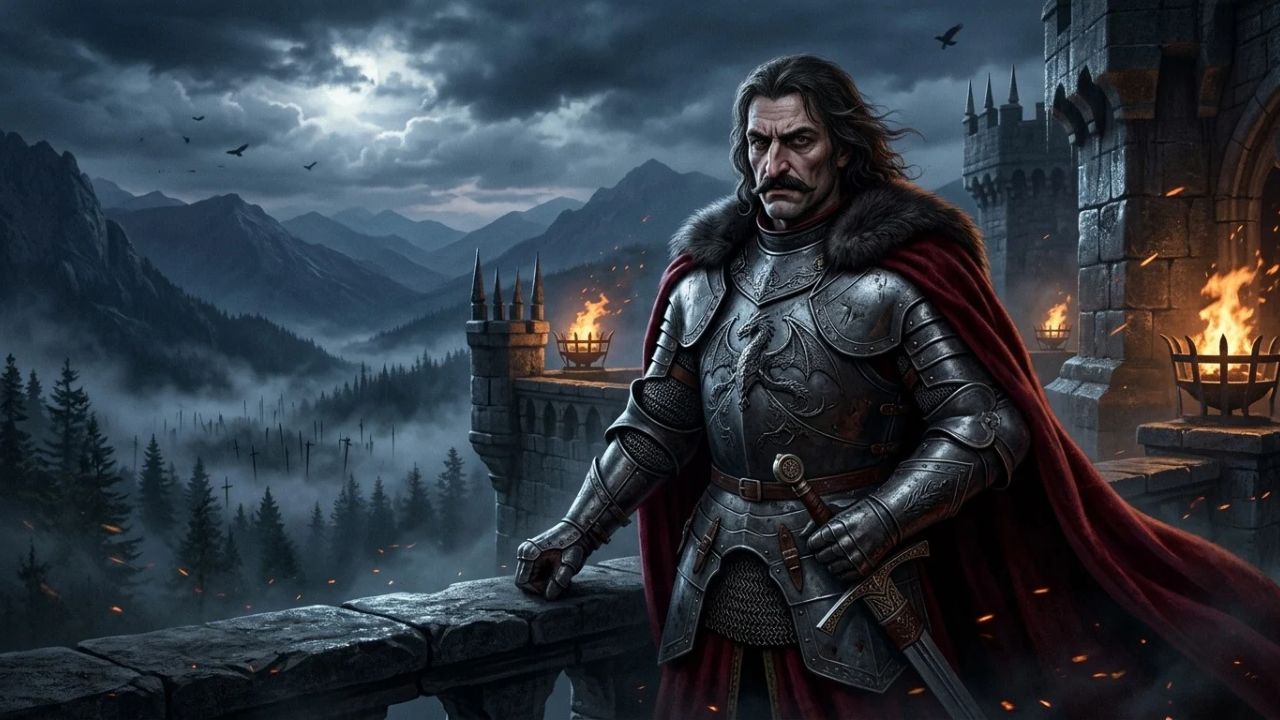
The actual historical figure who inspired the myth did not sleep in a velvet lined coffin or turn into a bat. Instead, he walked the blood soaked battlefields of 15th century Eastern Europe, wearing heavy steel armor, navigating intense political betrayals, and defending his territory with chilling, merciless brutality. Understanding the true story requires stepping away from Hollywood myths and diving deep into the grim realities of medieval geopolitics, where cruelty was often a calculated political weapon of survival.
🗡️ The Rise of Vlad III: Prince of Wallachia
To understand the man behind the myth, we must travel back to the mid-1400s. Vlad III, commonly known as Vlad the Impaler or Vlad Țepeș (meaning “the Impaler” in Romanian), was born around 1428 to 1431. He ruled Wallachia—a historical principality located in modern-day Romania—across three separate, turbulent periods: briefly in 1448, then during his main reign from 1456 to 1462, and finally in a brief return shortly before his death in late 1476.
His early life was defined by extreme instability and trauma. Geopolitically, Wallachia was trapped in a fierce squeeze between two crushing superpowers: the expanding Ottoman Empire to the south and the Kingdom of Hungary to the north. When Vlad was just a teenager, his father, Vlad II Dracul (who had joined the prestigious Order of the Dragon, hence the name “Dracul” or “Dragon”), sent Vlad and his younger brother Radu as political hostages to the Ottoman Sultan Murad II.
This captivity lasted for several years. While his brother Radu adapted to Ottoman court culture and won favor with the Sultan, young Vlad endured psychological isolation, witnessed arbitrary executions, and cultivated a deep seated resentment toward foreign conquerors. This formative trauma deeply shaped his uncompromising worldview and his future governing style.
🏛️ Law, Order, and the Forest of the Impaled
Upon reclaiming the Wallachian throne in 1456, Vlad inherited a fractured state plagued by rampant lawlessness, corruption among the boyars (the local nobility), and economic collapse. To restore order, Vlad implemented draconian laws that became legendary. Theft and treason were met with swift and brutal capital punishment.
According to historical chronicles and popular traveler tales of the era, Vlad wanted to test the honesty of his populace so intensely that he placed a solid gold cup in the central square of the capital. Anyone was free to drink from it, but the cup remained completely untouched out of sheer public terror.
His preferred method of execution, which earned him his terrifying moniker, was impalement. Victims—ranging from convicted criminals and corrupt merchants to captured Ottoman soldiers—were hoisted onto large, oiled wooden stakes designed to pierce the torso without instantly killing the victim, prolonging agony as a visual deterrent.
The most infamous example of his psychological warfare occurred in 1462 during the invasion of the Ottoman Sultan Mehmed II. As Mehmed’s massive army marched toward the Wallachian capital, they were met by the “Forest of the Impaled”—a ghastly spectacle featuring thousands of rotting Ottoman prisoners displayed on stakes stretching for miles across the plains. The psychological impact was so devastating that Sultan Mehmed II reportedly turned his army back, conceding that he could not conquer a man who was willing to do such unnatural things to his own and enemy lives.
📜 Propaganda, Print, and the Birth of a Monster
If Vlad was primarily a brutal political strategist defending his borders, how did he transform into an undead creature of the night? The transition from historical warlord to folklore monster was largely driven by medieval political propaganda and the brand new invention of the printing press.
Vlad made plenty of powerful enemies during his reign. Domestically, he executed numerous corrupt nobles to consolidate his absolute power. Internationally, he clashed constantly with Saxon merchants in neighboring Transylvanian towns like Brașov and Sibiu over trade tariffs and political alliances. Furthermore, King Matthias Corvinus of Hungary, who had previously supported Vlad, eventually arrested him in 1462 under politically motivated charges of treason, imprisoning him for over a decade.
To justify this arrest to the Pope and European allies, King Corvinus, alongside disgruntled Saxon merchants, commissioned and circulated sensationalist pamphlets detailing Vlad’s alleged atrocities. These early German broadsheets portrayed Vlad as a sadistic psychopath who supposedly dined among corpses or dipped his bread in human blood. With the rapid growth of the printing press, these lurid stories spread like wildfire across Europe, turning Vlad into a legendary bogeyman centuries before Bram Stoker ever opened a notebook.
✍️ From Historical Warlord to Bram Stoker’s Count
Fast forward to the late 19th century. Bram Stoker, an Irish theatre manager and author, spent years researching Eastern European folklore, regional superstitions about the undead (known in Balkan folklore as strigoi), and historical texts at the British Library.
Stoker stumbled across William Wilkinson’s 1820 book An Account of the Principalities of Wallachia and Moldavia, which mentioned the name “Dracula.” In the local Romanian language, “Drac” meant “dragon” or “devil,” making “Dracula” translate roughly to “son of the dragon”. Stoker loved the dramatic ring of the name and repurposed it for his fictional aristocratic villain.
Aside from the name, a few geographical references, and a brief historical monologue delivered by the fictional Count in the novel, Stoker’s vampire bore little resemblance to the actual historical prince. The real Vlad III was a defender of Christendom against the Ottoman advance, whereas Stoker’s Count was an ancient, aristocratic predator originating from the Carpathian Mountains.
🇲🇽 Economic Reality Check: Modern Tourism and Costs
For modern travelers looking to explore the historical footprints of Vlad the Impaler, visiting Romania offers a fascinating journey through medieval fortresses.
While Bran Castle is heavily marketed worldwide as “Dracula’s Castle”, historians note that Vlad likely never lived there and only had a very minor association with it. Instead, true enthusiasts visit the dramatic ruins of Poenari Castle—a cliffside fortress built by Vlad himself requiring a climb of over 1,480 stone steps—or the medieval town of Sighișoara, where Vlad III was born.
Planning a trip to these historic locations involves standard travel budgeting. Local tours, accommodations, and entry tickets are reasonably priced compared to Western European capitals. For instance, a traditional Romanian meal at a historic tavern typically costs around $15 to $25, while entrance fees to historical sites generally hover around $10 to $15. Budgeting for a week-long immersive historical tour across Transylvania and Wallachia averages roughly $800 to $1,200 per person, making it an affordable destination for history buffs seeking authentic dark tourism experiences.
🔍 Conclusion: Why the Legend Endures
The enduring fascination with Dracula proves that humanity has an eternal appetite for the dark and mysterious. The real Vlad III was a product of a brutally violent epoch where mercy was often treated as a fatal weakness. He was neither a blood-drinking immortal nor a purely malicious monster, but rather a complex, ruthless prince trying to keep his small nation alive amid a clash of giant empires.
By blending historical trauma with gothic imagination, Bram Stoker transformed a controversial 15th-century ruler into an eternal pop culture icon. Ultimately, the true story behind Dracula reminds us that history is often far stranger, darker, and more compelling than any fiction could ever hope to be.