
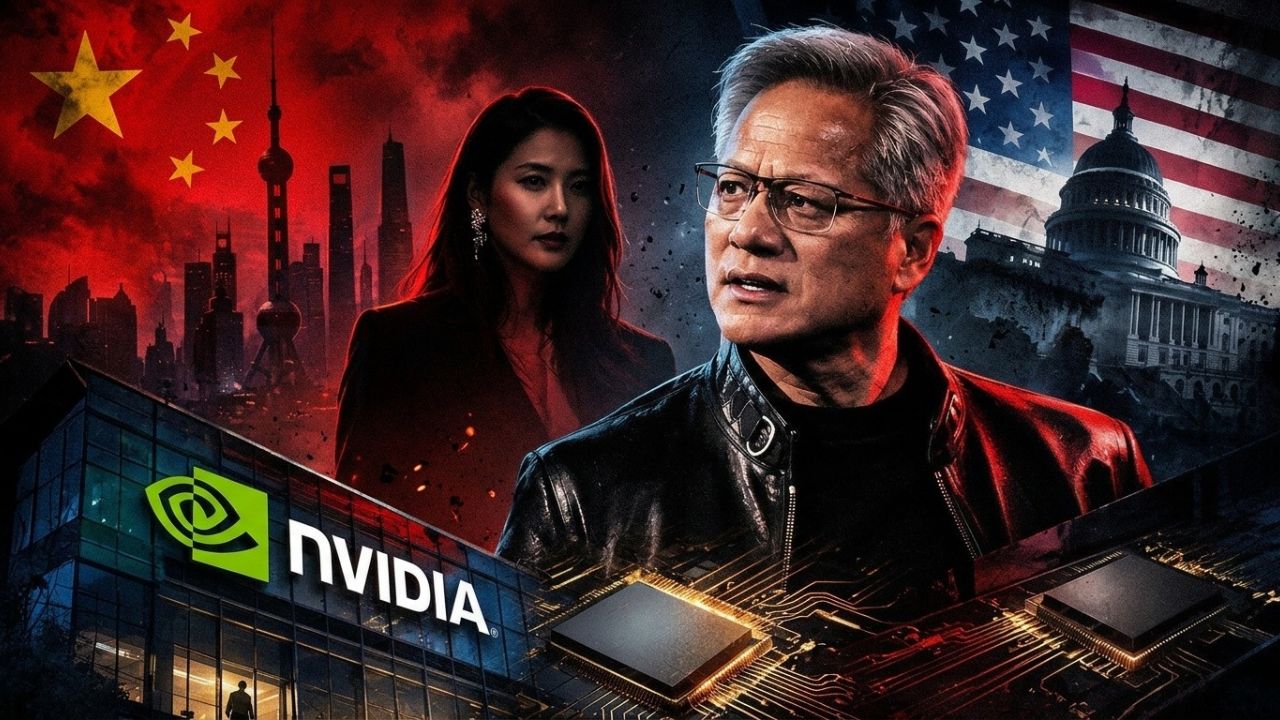
The sudden downfall of Nvidia founder Jensen Huang in a high-profile scandal involving a suspected Chinese spy has ignited a politically explosive question across Washington and Silicon Valley: who truly benefits from the removal of one of America’s most influential critics of microchip export restrictions on China?
Huang stepped down on Thursday following revelations of extramarital affairs, most notably with Chinese businesswoman Alice Huang, the former head of Singapore-based Megaspeed International, a major Nvidia customer. Anonymous US intelligence officials reportedly suspect that Beijing recruited her in an effort to potentially influence the Nvidia chief executive to lobby Washington to ease artificial intelligence chip export controls.
The controversy erupted at a remarkably sensitive juncture in the escalating US-China technology conflict, occurring just days before a scheduled summit between Presidents Donald Trump and Xi Jinping. With congressional hawks already agitating for sweeping new trade barriers, the timing of Huang’s abrupt exit has fueled intense speculation regarding the political and corporate interests served by his resignation.
🦅 Who Benefits From Huang’s Departure?
Huang’s resignation removes one of Washington’s most prominent and vocal advocates for keeping China connected to the American artificial intelligence ecosystem, potentially handing congressional China hawks a decisive political victory. For years, the Nvidia founder repeatedly warned lawmakers that severing Beijing from US semiconductor technology would backfire by accelerating China’s push for domestic self-reliance. In a May interview with Fox Business, Huang pointed directly to Huawei’s expanding market share, warning plainly: “They’re flourishing in our absence.”
His departure immediately intensified demands on Capitol Hill for stricter export controls and sweeping federal investigations into Nvidia’s overseas operations.
“Recent reports raise serious concerns about our national security and the protection of sensitive U.S. technology. I am requesting that NVIDIA CEO Jensen Huang and Commerce Secretary Howard Lutnick testify before the Senate Banking Committee. The American people deserve answers.”
— Senator Tim Scott
Republican Representative John Moolenaar, chairman of the House Select Committee on China, quickly seized upon the scandal to question whether Chinese intelligence had acquired sensitive proprietary data through Huang or covertly shaped US technology policy. “[Huang has] been one of the strongest proponents for not having export controls,” Moolenaar stated. “This shines a whole new light on that discussion.” Meanwhile, House Foreign Affairs Committee Chairman Brian Mast has renewed his push for tighter regulatory safeguards, including aggressive measures to curb chip smuggling and restrict foreign access to advanced semiconductor manufacturing equipment.
Senate Democratic Leader Chuck Schumer echoed the call for accountability across both the private sector and the executive branch. “Despite Jensen Huang’s resignation, Congress must demand answers from Mr. Huang and others at Nvidia about how they may have put U.S. national security at risk,” Schumer wrote on social media. “The Trump administration must also answer for what it did once it learned about Mr. Huang’s relationship.”
President Donald Trump, however, publicly defended Huang as a “very honorable guy” and stated that he believed the executive’s denial that he knew Alice Huang was allegedly involved in espionage. Nevertheless, the political fallout has handed advocates of strict technological containment fresh ammunition against one of their most formidable opponents.
💻 Rival AI Giants or National Security Hawks?
Beyond the halls of Congress, Huang’s sudden ouster has sparked intense debate over whether rival American technology firms stand to profit from his removal.
Independent investigative journalist Lee Fang suggested that competing US artificial intelligence companies could be major beneficiaries, pointing to Huang’s outspoken support for lower-cost Chinese open-source AI models that threaten the business models of established American tech giants. Fang drew direct historical parallels to previous corporate-backed lobbying campaigns aimed at neutralizing foreign competitors.
“What are the odds American AI firms are playing some role in the Huang ouster? In the same way Cisco paid PR firms to spread fears about Huawei and Meta paid PR firms to stir demands for banning competitor TikTok? Huang singularly pushed cheaper Chinese open source models.”
— Lee Fang, Investigative Journalist
Venice AI founder Erik Voorhees went even further in his assessment, characterizing Huang’s removal from the company he built as nothing short of a “coup.” Similarly, journalist Glenn Greenwald questioned whether personal indiscretions alone could explain the rapid takedown of one of the world’s most powerful corporate leaders. “I don’t know who wanted Jensen Huang out, but I know that whoever it was wields extreme levels of power,” Greenwald noted.
Across Silicon Valley, the resignation triggered an immediate wave of shock and pushback from prominent industry figures:
- Elon Musk remarked that hiring Huang would be “an honor.”
- Tim Sweeney, chief executive of Epic Games, called the exit “a sad day for NVIDIA, developers, America, and all humanity,” praising Huang for driving continuous innovation without falling into “the trap of ever-increasing extraction.”
- Changpeng Zhao, founder of Binance, labeled the resignation “a mistake.”
- Martin Casado, general partner at venture capital firm Andreessen Horowitz, described it as a “dark, dark day” and a “horrible decision for the US and the western world.”
📰 Questions Over How the Story Reached the Press
Scrutiny has also turned toward the media mechanics behind the bombshell revelations. New York Times reporter Tripp Mickle, who co-authored the initial investigation into Huang’s affair, disclosed during an appearance on The Daily podcast that he and colleague Ana Swanson began looking into Megaspeed after receiving a tip from an unnamed technology industry contact.
That admission has reinforced suspicions among industry observers that journalists may have been strategically steered toward Megaspeed by an insider with an agenda, raising further questions about who supplied the original lead and what motivated the timing of the leak.
🏛️ What Did Washington Know, and When?
The political intrigue deepened following reports that senior US government officials were aware of Huang’s relationship with Alice Huang months before the scandal became public knowledge.
According to Axios, a highly classified intelligence memorandum overseen by Secretary of State Marco Rubio circulated inside the administration prior to President Trump’s May visit to China. Based on surveillance of Alice Huang and a broader probe into suspected chip smuggling involving Megaspeed, the intelligence warning reportedly reached Commerce Secretary Howard Lutnick, while Rubio also briefed President Trump directly.
Megaspeed operates high-capacity AI computing infrastructure, allowing clients to remotely rent access to advanced Nvidia processors outside mainland China. National security officials have long viewed such cloud-rental arrangements as a potential loophole around export restrictions designed to block direct shipments of cutting-edge hardware to Chinese entities.
At the same time, Washington was simultaneously authorizing certain direct sales to Chinese buyers. In May, Reuters reported that roughly ten Chinese companies had received federal clearance to purchase Nvidia’s H200 processors, though physical deliveries had not yet commenced. Those approvals were handled separately from the Megaspeed investigation, leaving the exact timeline relative to the intelligence warning unclear.
Internal disagreements over how to handle Megaspeed reportedly reached the upper echelons of the Trump cabinet. Axios reported that Treasury Secretary Scott Bessent confronted Lutnick over his failure to place Megaspeed on a trade blacklist despite repeated intelligence warnings. While the Commerce Department flatly denied that any such confrontation occurred, Lutnick now faces mounting congressional scrutiny over his agency’s oversight of semiconductor exports and potential diversion networks.
If top officials in Washington possessed intelligence warnings months earlier, analysts ask, why did the allegations erupt into a public crisis only on the eve of a major US-China diplomatic summit?
🇸🇬 Singapore’s Investigation and Fractured US Intelligence
Long before Alice Huang’s alleged links to Chinese intelligence became the centerpiece of an American political firestorm, authorities in Singapore had already been investigating her former company.
In an official statement released on Thursday, Singapore’s Ministry of Home Affairs confirmed that local police launched an investigation into Megaspeed International in February 2025 over suspected false customs declarations involving servers shipped through Singapore to Malaysia.
| Date | Key Development in Singapore Probe |
| February 2025 | Singapore police open investigation into Megaspeed over suspected false server declarations. |
| June 2025 | Alice Huang is questioned by authorities and has her passport seized. |
| February 2026 | Investigators find insufficient evidence of the suspected trade offenses; she receives a formal warning for inaccurate statements regarding her role and is barred from re-entering Singapore. |
Crucially, Singaporean authorities emphasized that Alice Huang had never been investigated for espionage.
Meanwhile, the narrative that she operated as a Chinese intelligence asset has encountered growing skepticism within Washington itself. According to CNN, US intelligence agencies remain sharply divided over whether existing evidence actually proves she worked on behalf of Beijing. Attorney General Todd Blanche stated that the Justice Department had reached “no conclusions” regarding her alleged intelligence ties.
White House AI and crypto advisor David Sacks highlighted the apparent collapse of the espionage narrative on social media, pointing out that the Justice Department had reached no conclusions, the CIA remained unconvinced, and the Office of the Director of National Intelligence viewed the claims as over-torqued. These conflicting assessments leave a critical question unresolved: how did an unverified espionage allegation gain enough momentum to force out the leader of one of the world’s most valuable companies?
🌐 Nvidia’s Role and the Export Control Paradox
Founded by Huang in 1993, Nvidia evolved from a graphics card maker into the indispensable hardware and software backbone of the global artificial intelligence revolution. Because its processors power advanced data centers worldwide, the company sits at the very center of Washington’s geopolitical competition with Beijing.
By restricting exports of high-end chips, US policymakers seek to limit China’s ability to train frontier AI models for military and intelligence applications. Critics, however, view the policy as a broader strategy of technological containment aimed at locking in American economic supremacy.
The central dilemma Huang repeatedly warned about remains unresolved: cutting China off from Nvidia’s ecosystem risks accelerating Beijing’s drive to build an independent, non-American semiconductor supply chain. Chinese tech champions such as Huawei are pouring vast resources into domestic alternatives, while an August regulatory filing from Nvidia acknowledged that overlapping US and Chinese restrictions had effectively locked the company out of China’s data-center market. In that filing, Nvidia warned that its absence was enabling rival platforms to expand their developer networks globally.
🔄 Who Will Take Control of Nvidia Now?
Huang’s abrupt exit has plunged Nvidia into an unprecedented leadership transition. According to Wired, an internal company message board post urging the board of directors to weigh employee sentiment drew more than 1,600 comments, with many staffers voicing strong support for Huang’s eventual return.
For now, longtime Chief Financial Officer Colette Kress has stepped in as interim chief executive while the board searches for a permanent successor. Industry observers and prediction markets have floated several prominent contenders to lead the chipmaker through this geopolitical minefield:
- Internal Veterans: Interim CEO Colette Kress and Nvidia executive Ian Buck, a primary architect of the company’s dominant CUDA software platform, alongside Chief Technology Officer Michael Kagan.
- Family Leadership: Madison Huang, Jensen Huang’s daughter, who currently serves as a senior marketing director at Nvidia and has emerged as a leading contender on prediction platform Polymarket.
- External Industry Titans: Apple hardware chief Johny Srouji, Arm CEO Rene Haas, AMD chief executive Lisa Su, and Mellanox founder Eyal Waldman.
- Political Endorsements: President Trump publicly endorsed former Apple CEO and current executive chairman Tim Cook on Truth Social, declaring that “a Legend replaces a Legend.”
Whoever ultimately takes the helm at Nvidia will inherit a corporate titan caught squarely in the crossfire of superpower rivalry. The next chief executive will face an immediate strategic choice: continue Huang’s push to keep global AI standards anchored to American technology through commercial engagement, or align Nvidia more closely with Washington’s hardline containment doctrine.