
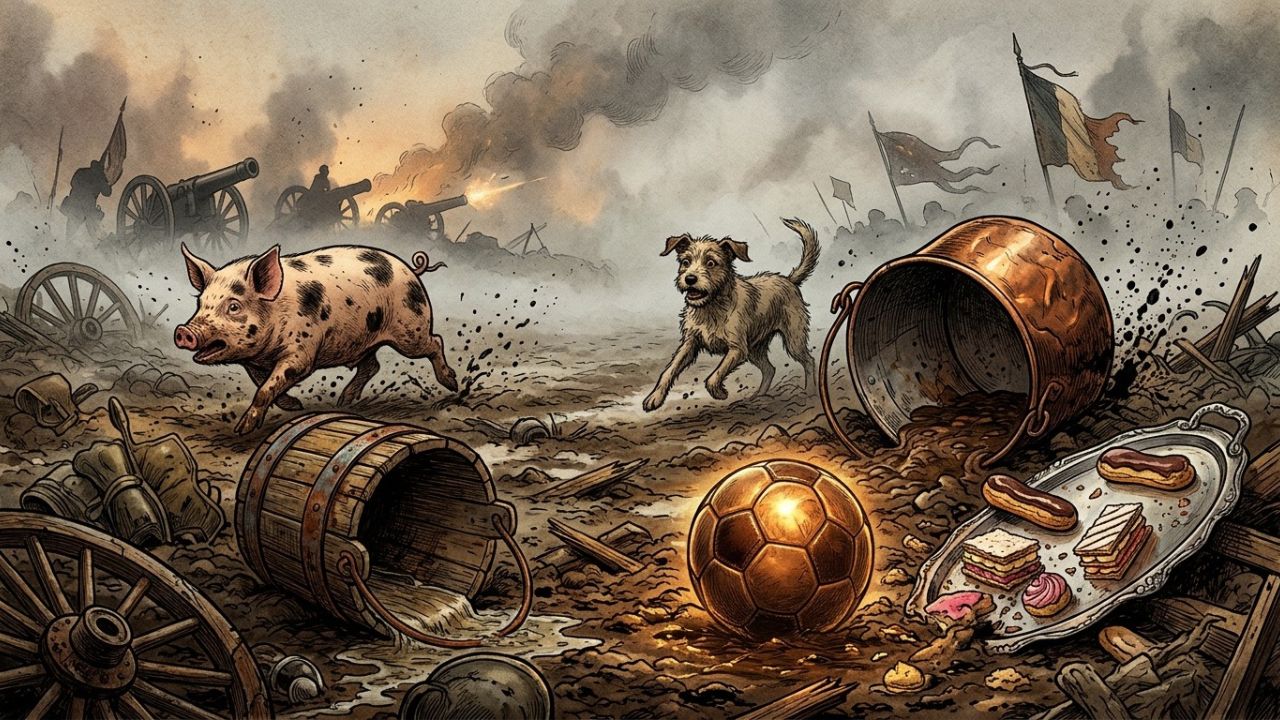
History books usually frame armed conflicts around grand geopolitical forces: scarce resources, shifting alliances, religious schisms, or competing empires. Yet when reporters and historians peel back the official declarations, the immediate sparks of several notorious clashes look remarkably petty, bizarre, or downright absurd. A stolen water bucket, a hungry pig, a ruined bakery, a severed ear, a bitter soccer match, a stray dog, and a soup kettle have all played starring roles in igniting real diplomatic crises and military confrontations.
Of course, trivial triggers rarely act in a vacuum. Deep-seated rivalries, unresolved border disputes, trade grievances, and bruised national pride usually sit like dry tinder long before the spark hits. Still, watching empires and neighbors mobilize over objects worth a few dollars or grievances that sound like sitcom plots reveals a sobering truth about human nature: pride and escalation can turn almost anything into a casus belli.
1. The War of the Oaken Bucket (1325): A Well Worth Thousands of Lives
In northern Italy during the fourteenth century, rival city-states needed very little excuse to fight. Bologna aligned with the papacy, while Modena backed the Holy Roman Emperor, and hostilities between the two neighbors simmered for decades. In 1325, soldiers from Modena slipped into Bologna and made off with a wooden bucket taken from a city well.
To a modern observer, stealing a piece of cooperage worth less than $10 in today’s terms seems like a minor prank. In fourteenth-century municipal politics, however, public humiliation was a serious matter. Bologna demanded the bucket’s return, Modena refused, and Bologna mobilized an army reported in historical accounts at roughly 30,000 men to march against a much smaller Modenese force of around 7,000.
The resulting Battle of Zappolino ended in a stunning reversal for the larger army. Modena’s forces routed the Bolognese troops, inflicting heavy casualties on both sides. Modena kept the wooden bucket as a trophy, and centuries later it remains preserved in Modena as a reminder that civic pride can turn trivial theft into bloodshed.
2. The Pig War (1859): One Potato Raid and a Tense Standoff 🐷
Along the Pacific Northwest border between Washington Territory and Vancouver Island, Britain and the United States shared an ambiguous boundary in the San Juan Islands throughout the mid-nineteenth century. Both nations claimed control of the islands, leaving American settlers and British Hudson’s Bay Company employees living side by side in uneasy proximity.
The flashpoint arrived on June 15, 1859, when American farmer Lyman Cutlar discovered a large Berkshire boar rooting through his potato patch. The pig belonged to Charles Griffin, a British employee who ran sheep on the island. Cutlar shot the animal dead, then offered Griffin $10 in compensation. Griffin rejected the payment, demanding $100 instead, and British authorities threatened Cutlar with arrest.
What began as a barnyard dispute quickly escalated into a full-blown military standoff. American troops arrived under Captain George Pickett, while British warships anchored offshore with cannons trained on the island. Miraculously, disciplined restraint prevented shots from being fired between the two forces, and international arbitration eventually settled the border in 1872. The only fatality of the crisis was the potato-loving pig.
3. The Pastry War (1838): Unpaid Cakes and Cannon Fire 🥐
Few conflicts carry a culinary nickname quite as memorable as the Pastry War, known in Spanish as the Guerra de los Pasteles and in French as the Guerre des Pâtisseries. Following Mexico’s independence from Spain, the young nation experienced frequent political turmoil, civil unrest, and financial strain that left foreign residents vulnerable to property damage without reliable recourse.
Around 1828, a French pastry chef named Remontel operated a shop near Mexico City that was looted and damaged during political disturbances involving Mexican officers. Remontel sought compensation for his ruined pastries and shop, eventually appealing to the French government for a claim estimated at 600,000 pesos. When Mexico’s government refused to pay, France decided that diplomatic patience had run out.
In late 1838, France dispatched a naval squadron to blockade Mexican ports and bombarded the fortress of San Juan de Ulúa and the port city of Veracruz. Mexican forces fought back, and General Antonio López de Santa Anna famously lost a leg to cannon fire during the defense of Veracruz. By early 1839, mediated by Britain, Mexico agreed to pay the indemnity, ending a brief but destructive conflict sparked in part by a baker’s bill.
4. The War of Jenkins’ Ear (1739): A Severed Ear in Parliament 👂
Eighteenth-century maritime trade between Britain and Spain was rife with friction, smuggling, and aggressive boarding practices. Under the Asiento agreement, Britain held limited rights to trade with Spanish colonies in the Americas, but Spanish authorities suspected British merchants of routinely exceeding those limits and clamped down hard on suspected smugglers.
In 1731, Spanish coast guards boarded the British brig Rebecca, commanded by Captain Robert Jenkins. Accounts of the encounter vary in detail, but Jenkins reported that his attackers sliced off his ear and told him to take it to his king, George II. Years later, in 1738, Jenkins appeared before a committee of the British House of Commons carrying what he presented as his preserved ear.
Opposition politicians and pro-war factions seized on the dramatic display to whip up public anger against Spain. While commercial rivalry and imperial competition were the real strategic drivers behind the conflict, the severed ear gave British hawks an unforgettable rallying cry when war was formally declared in 1739. The conflict soon merged into the wider War of the Austrian Succession, proving how potent a single shocking prop can be in wartime propaganda.
5. The Football War (1969): World Cup Qualifiers Turn Deadly ⚽
In June 1969, El Salvador and Honduras met in a high-stakes qualifying series for the 1970 FIFA World Cup. Sporting rivalries between neighboring countries already ran hot, and in this case they overlapped with deep economic tensions, trade disputes, and long-standing friction over migration and land in Central America.
Each country won its home match amid intense pressure, fan clashes, and heated media coverage, forcing a decisive third game in Mexico City. El Salvador won that playoff match in extra time, pushing nationalist emotions past the breaking point. Within days, Honduras severed diplomatic ties, and on July 14, 1969, Salvadoran forces launched air strikes and a ground invasion across the border.
The fighting lasted roughly four to five days before intervention by the Organization of American States forced a ceasefire. Although soccer did not create the underlying structural problems between El Salvador and Honduras, the World Cup qualifiers acted as the immediate fuse for a conflict that claimed thousands of lives and displaced tens of thousands more.
6. The War of the Stray Dog (1925): Chasing a Pet Across the Border 🐕
Post-World War I Europe remained fragile, with newly drawn borders and lingering animosities between neighboring states. Greece and Bulgaria shared a tense frontier marked by sporadic border incidents and mutual distrust in the mid-1920s.
According to widely repeated accounts of the October 1925 incident near Petrich, a Greek soldier’s dog bolted across the border into Bulgarian territory. When the soldier ran after the dog, Bulgarian border guards shot and killed him. News of the shooting triggered fierce outrage in Athens.
Greece issued an ultimatum and sent troops across the border into Bulgaria, prompting rapid diplomatic alarm. Bulgaria appealed to the League of Nations, which intervened swiftly, ordered a halt to hostilities, and imposed financial reparations on Greece. Dozens of people died in the brief clash, making a wandering dog’s detour one of the strangest catalysts of interwar Europe.
7. The Kettle War (1784): A Soup Kettle Ends the Show 🍲
Not every absurd conflict ends in heavy slaughter; sometimes a single piece of cookware steals the spotlight and defuses the drama. In the 1780s, Holy Roman Emperor Joseph II sought to reopen navigation along the Scheldt River, a vital waterway whose mouth was controlled by the Dutch Republic. Restricting access to the river protected Dutch commercial dominance while frustrating imperial trade ambitions.
In 1784, Joseph II tested Dutch resolve by sending imperial vessels down the Scheldt. The Dutch responded by deploying ships to guard the waterway. During the confrontation, a Dutch cannon shot struck a ship in the imperial flotilla—and famously punctured a soup kettle on board.
No one was killed in the exchange, and the incident quickly turned into a punchline across Europe. Diplomatic negotiations followed, and in 1785 the Treaty of Fontainebleau settled the dispute with financial payments rather than sustained warfare. A ruined pot of soup became the unlikely symbol of a conflict that fizzled before it could truly begin.
Quick Summary of Petty Sparks 🗂️
| Conflict | Year | Absurd Spark | Underlying Issue | Outcome |
| War of the Oaken Bucket | 1325 | Stolen wooden well bucket | Papal vs. imperial rivalry in Italy | Modena won and kept the bucket |
| Pig War | 1859 | Pig shot for eating potatoes | Disputed San Juan Islands border | Peaceful arbitration in 1872 |
| Pastry War | 1838 | Unpaid damages for a bakery | French claims and Mexican unrest | Mexico agreed to pay damages |
| War of Jenkins’ Ear | 1739 | Ear shown in Parliament | Colonial trade and smuggling disputes | Merged into broader European war |
| Football War | 1969 | World Cup qualifying matches | Migration, land, and trade friction | Ceasefire after days of fighting |
| War of the Stray Dog | 1925 | Dog ran across the border | Post-WWI border tension | League of Nations halted clash |
| Kettle War | 1784 | Cannonball hit a soup kettle | Control of the Scheldt River | Settled diplomatically in 1785 |