
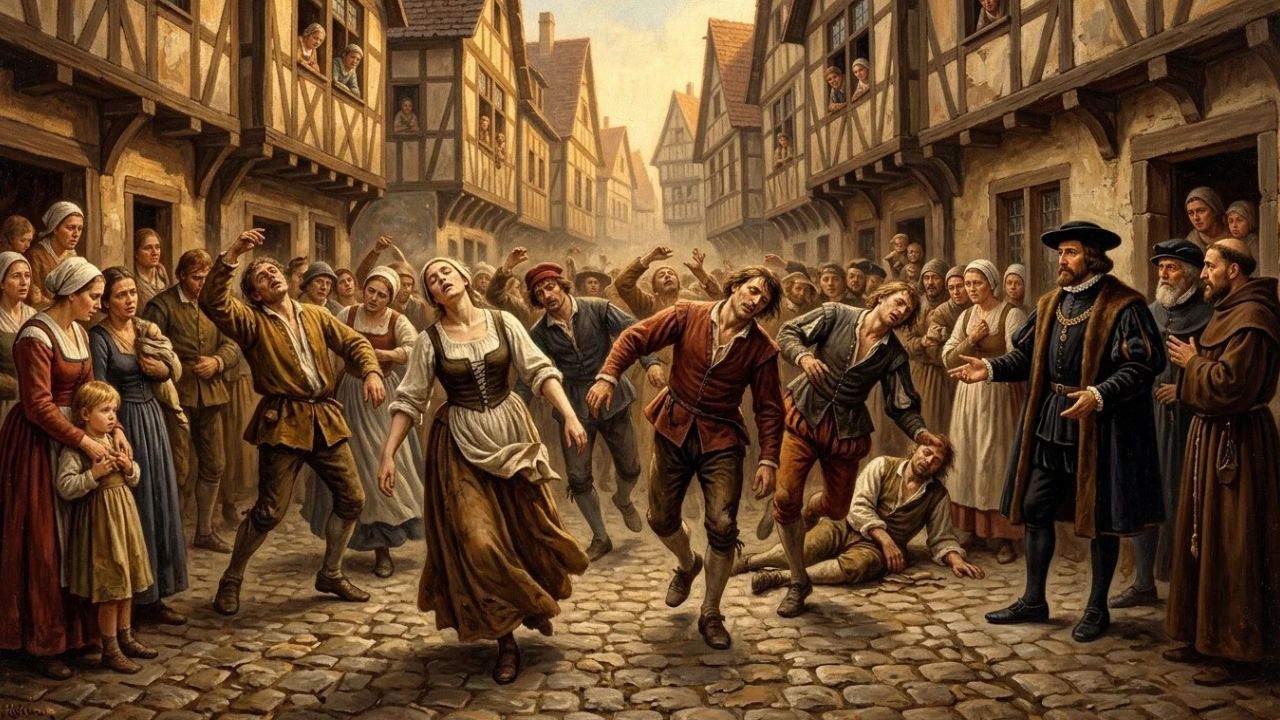
In mid-July 1518, a woman named Frau Troffea stepped onto a narrow cobblestone street in Strasbourg, a prosperous free imperial city in the Holy Roman Empire, and began to dance. There was no tavern lute, no street festival, and no celebration to mark the occasion. Yet Troffea twisted, swayed, and stamped her feet with relentless energy until dusk turned her movements into a twitching collapse. When morning came, despite her husband’s pleas and feet swelling inside her shoes, she rose and began again.
Within a week, roughly three dozen neighbors had joined her. Within a month, chroniclers recorded that as many as 400 residents of Strasbourg were caught in an involuntary, exhausting dance that lasted day and night. Five centuries later, the dancing plague of 1518 remains one of history’s strangest public health enigmas, pitting sixteenth-century medicine and religious superstition against modern psychology, toxicology, and epidemiology.
🩰 A Midsummer Outbreak in Strasbourg
Strasbourg in the summer of 1518 was a bustling hub along the Rhine frontier, yet life behind its half-timbered facades carried heavy burdens. Food shortages, recurring outbreaks of disease, economic strain, and harsh weather had left ordinary townspeople on edge. When Frau Troffea started moving without pause, onlookers initially stared in confusion, then watched as other citizens, from day laborers to clergy, stepped into the rhythm.
Historical chronicles describe scenes far removed from joyous celebration. Witnesses reported dancers with glassy, vacant eyes, drenched clothing, and spasmodic movements. Many danced without eating or sleeping, pushing past severe fatigue until blisters broke and blood soaked into their clogs and leather boots.
| Aspect of the Outbreak | Historical Record Details |
| Location & Time | Strasbourg (Holy Roman Empire); July to September 1518 |
| First Reported Figure | Frau Troffea, who danced for days before others joined |
| Estimated Scale | Roughly 30 within the first week; up to 400 over the following weeks |
| Official City Response | Cleared guild halls, built stages, hired musicians, then later shifted to religious shrines |
| Reported Toll | Severe exhaustion and collapse; later chronicles claim deaths from heart strain or strokes |
🩺 Doctors, Musicians, and a Backfired Cure
Faced with a growing crowd of exhausted dancers, Strasbourg’s magistrates and physicians turned to the medical wisdom of the era. Renaissance doctors frequently linked erratic behavior to humoral imbalance, arguing that the dancers suffered from “overheated blood” or overheated brains. Oddly enough, their prescription was not rest, which they feared might allow thick, hot humors to settle harmfully, but more dancing to burn off the excess heat.
Acting on that advice, city leaders opened guild halls, erected wooden stages near the horse market, and paid drummers, pipers, and professional dancers to keep the sufferers moving. Instead of ending the ordeal, the music and public spectacle appeared to draw more people in. Heat, dehydration, lack of sleep, and constant strain took a heavy toll, with later accounts noting collapses and deaths attributed to heart attacks, strokes, or sheer physical depletion.
As the crisis dragged on into late summer, authorities reversed course. They dismantled stages, curtailed public musical encouragement, and arranged for afflicted dancers to be transported toward Saverne to seek healing at a shrine dedicated to Saint Vitus, a Christian saint widely invoked in folk belief against nervous spasms and dancing curses. By early September, the frenzy subsided.
🧠 Stress, Hysteria, and Modern Theories
Because no single medical test existed in 1518, modern historians, neurologists, and psychologists have debated what truly drove hundreds of people to dance until collapse. No single explanation commands universal agreement, yet several leading hypotheses stand out:
- Stress-induced mass hysteria: Historian John Waller and other scholars have argued that extreme psychological pressure, famine, disease, and fear of divine punishment triggered a dissociative, contagious response. Once people believed Saint Vitus could curse them with unstoppable dancing, fear itself could prime suggestible individuals to enter trance-like states.
- Ergot poisoning: An older theory proposed that residents ate bread or grain contaminated by ergot, a fungus that grows on damp rye and produces psychoactive compounds chemically related to LSD along with vasoconstriction and spasms. Critics point out that severe ergotism often causes burning limbs, gangrene, or immobilization rather than sustained, coordinated dancing across hundreds of people over weeks.
- Neurological or infectious illness: Conditions such as encephalitis, typhus, or movement disorders can produce involuntary twitches, tremors, or altered mental states. However, specialists note that these illnesses rarely produce prolonged, rhythmic dancing across large groups of bystanders in public squares.
- Social and religious tension: Early sixteenth-century Europe stood on the threshold of profound religious upheaval, just a year after Martin Luther posted his ninety-five theses in 1517. Shared anxiety, ritual expectations, and collective grief may have shaped how distress surfaced in public.
⏳ Echoes Across Centuries
Strasbourg was not the first or last European town to witness dancing mania. Chronicles record earlier outbreaks along the Rhine and Moselle rivers, including a notable episode in 1374, as well as later incidents in the Low Countries and German territories. What sets 1518 apart is the unusual density of surviving records, civic involvement, and vivid human detail preserved by chroniclers and later commentators, including the sixteenth-century physician Paracelsus.
Even today, the episode lingers in modern culture as a haunting reminder of how fragile the boundary between mind and body can be under severe stress. Filmmakers, musicians, and historians still return to those hot July cobblestones in Strasbourg, searching for clarity in a story where ordinary citizens moved to a rhythm no one else could hear.