
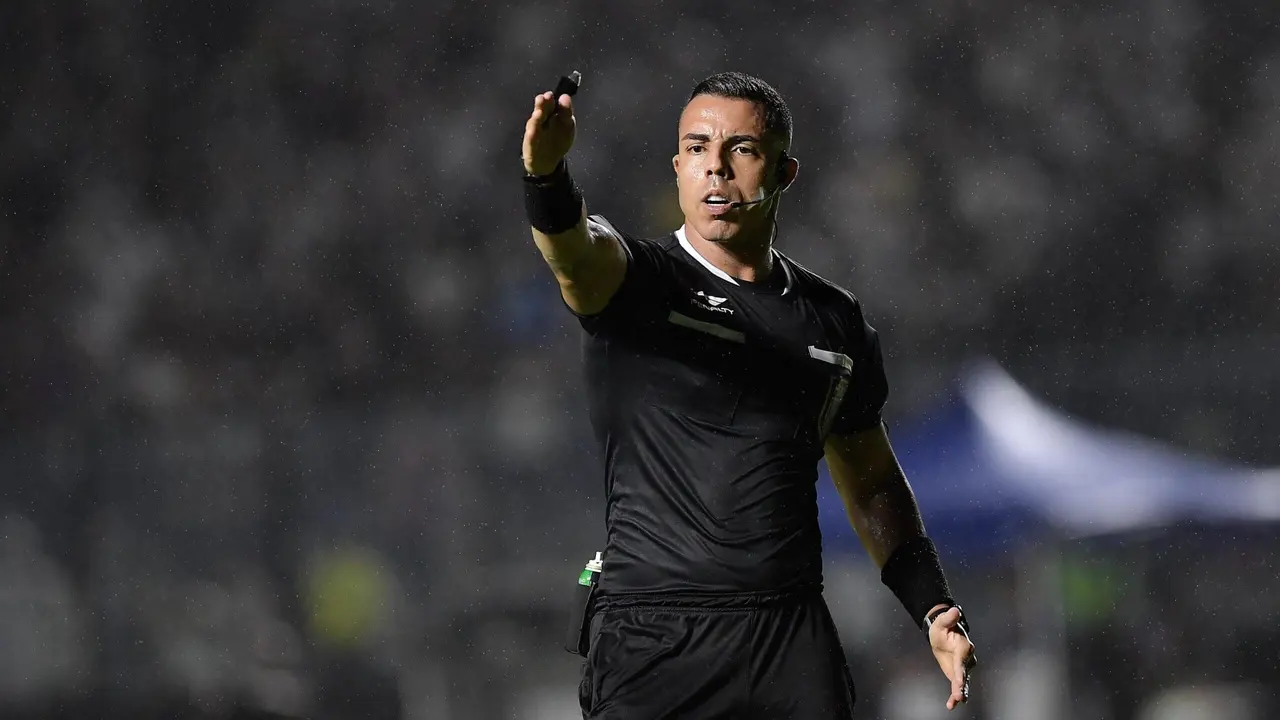
O soccer it is a sport of subjective timers and emotions that often defy the logic of linear time. Unlike sports such as basketball or American football, where the stopwatch or the siren automatically ends the match, in football the sovereignty of time belongs exclusively to the central referee. This characteristic creates dramatic and often controversial scenarios, especially when an imminent attack is interrupted by the final whistle at the exact moment the ball moves towards the back of the net. Lance! Explain what happens if time runs out during the ball's trajectory?
continues after advertising
➡️ Follow Lance! on WhatsApp and follow the main sports news in real time
Unlike other sports where a shot made before the sound signal is validated even if the ball enters the basket with time already up, football operates under an absolute metric of immediate interruption. If the referee decides that regulation time and stoppage time have been completed, the sound of the whistle ends jurisdiction of the play in the millisecond in which it is sounded. This means that the ball's trajectory, no matter how promising or cinematic it may be, loses any legal value as soon as the match is officially declared over by the referee's sound command.
What happens if time runs out during the ball's trajectory?
Rule 7 of the International Football Association Board (IFAB), which deals with the duration of the match, establishes the basis for controlling time, but it is in the interpretation of the ending that the biggest technical debates arise about what happens if time runs out during the ball's trajectory. For the average fan, it seems unfair to cancel a goal that was about to happen, but for the law of the game, the accuracy of the closure is a question of the integrity of the regulations. The subjectivity of stoppage time, managed by the referee, is the only mechanism that allows the match to last longer than expected, but once the limit is reached, the ball in the air does not guarantee the continuity of the play.
continues after advertising
The frustration of seeing a winning goal invalidated by the final whistle is one of the most tense moments in sport and serves to highlight the unique authority that the referee exercises within the four lines. This discretionary power is often tested in high-level competitions, where every second of advertising and every tactical detail is monitored by millions of people. The rule is relentless: the match ends when the referee blows the whistle, not when the ball stops moving or crosses a specific lineexcept for a single and important technical exception provided for in the official FIFA text.
In this article, we will analyze in depth what the Laws of the Game determine regarding the end of the match while the ball is in flight. Let's explore referee sovereignty, the fundamental difference between football and “buzzer beater” sports, and the specific rule that requires an extension of time for penalty kicks. Additionally, we will revisit historical cases that shaped the way referees are instructed today to avoid unnecessary controversy on the last play of the game, ensuring that sporting justice prevails over clock chaos.
continues after advertising
Rule 7 sovereignty and what happens if time runs out during the ball's trajectory?
Rule 7 of the Laws of the Game states that each match has two 45-minute periods unless there is a different agreement between the referee and the two teams before the start. The referee is responsible for adding time lost in each period due to substitutions, injury assessments, goal celebrations or any other cause of delay, including the use of VAR. However, the text is clear: “the referee ends each period at the end of the regulation time and the additional time granted”.
Technically, the game ends the moment the referee starts to blow the whistle. If the ball is in mid-flight after a long-range shot and the referee blows the whistle before it crosses the goal line, the goal must not be awarded. In football, there is no concept of “completing the play” after time has run out. From the moment the buzzer sounds, the ball is considered out of play (or play is considered non-existent for scoring purposes), regardless of where it is or where it is going.
This rigidity serves to maintain absolute control over the duration of the event. If referees allowed each attack to be completed, stoppage time would become elastic and unpredictable, creating unfair advantages for teams that manage to extend their possession in the final seconds. Therefore, the ball's trajectory is legally interrupted by the whistle, transforming what would be a historic goal into a dead shot without any effect on the official result.
Football vs. Basketball: the paradox of the last second and the difference between the rules
One of the most frequent comparisons made by data analysts and American sports fans is the contrast between football and basketball (NBA). In basketball, the “shot clock” and game clock rule allows that, if the ball leaves the shooter's hands before the clock runs out, points are scored even if the net swings with the clock reset. This is the famous “buzzer beater”. In football, this concept simply does not exist in the form of law.
The reason for this difference lies in the nature of timekeeping. In basketball, the time is exact, monitored by a control table and stopped at each interruption. In football, time is continuous and the management of stoppage time is an estimate by the referee. As the referee has the freedom to add thirty seconds or an extra minute beyond what was originally announced by the fourth official, IFAB understands that he has already had the opportunity to make up for lost time. Therefore, the final whistle must be the absolute end point of the dispute, with no room for extensions based on the movement of the ball.
This distinction requires football players to have a much more acute perception of time. In last-second attacks, the athlete must seek the submission as quickly as possible, aware that the referee is not obliged to wait for the ball to reach the target. It's a race against man and the clock, where the sound of the whistle is the only judge that separates glory from technical oblivion.
The mandatory exception to the rule: the maximum penalty
Although the closing rule is strict, there is a fundamental exception described in Rule 7 itself and reinforced in Rule 14 (The Penalty). If a penalty is awarded at the last moment of a period, the referee must extend the time for the penalty to be taken and completed. This is the only scenario in football where playing time is technically “stopped” so that a ball's trajectory can be completed.
In this specific situation, the time is extended until the penalty produces one of the following results:
- The ball goes directly into the goal (validated goal).
- The ball goes out of bounds (end of game).
- The ball stops moving or is saved by the goalkeeper without a goal being scored (game over).
- The referee stops the game for an infraction committed by the batsman or his team.
If the goalkeeper saves the ball and it bounces back to the striker, who kicks the ball again at the goal, this second shot is no longer valid, as the “conclusion” of the penalty occurred in the initial defense. The extended time is only for the single act of the penalty. This exception exists because the penalty is considered a maximum punishment that cannot be avoided by the chronological end of the game, ensuring that the team harmed by the foul has its opportunity for compensation guaranteed by law.
FIFA instructions and “common sense” in refereeing
Despite the coldness of the rules, FIFA and national refereeing commissions instruct judges to use common sense when ending the match. The general guideline is to avoid blowing the whistle for the end of the game when a team is in a dangerous attack, inside the opponent's area or about to take a shot. This is not a written rule, but rather a game management guideline to avoid unnecessary conflicts and controversies that tarnish the show.
An experienced referee usually waits for the ball to leave a danger zone or possession to change sides before blowing the final whistle. If a team is about to take a corner kick in the 50th minute of the second half (in five minutes' injury time), the referee has the option of letting the kick take place. However, if he whistles before the kick or while the ball is in the air from the corner, he will be technically correct under the Laws of the Game, even if he suffers intense criticism from the injured team.
The modernization of arbitration, with the help of VAR, brought extra pressure on this moment. VAR cannot validate a goal if the referee whistled before the ball went in, even if technology shows that there was no foul or offside. The whistle stops the game immediately and nothing that happens after that has technical validity, which reinforces the need for referees to be cautious and precise when ending the confrontation.
Historical cases and last-second controversies
The most famous case of “time out with the ball in the air” occurred at the 1978 World Cup in Argentina. In the game between Brazil and Sweden, the score was tied at 1-1. In the 45th minute of the second half, Brazil had a corner kick in their favor. Nelinho took the ball into the area and Zico headed it into the back of the net. However, Welsh referee Clive Thomas whistled the game over as the ball traveled in the air between the cross and the header. The goal was disallowed, the game ended in a draw and Clive Thomas went down in history as the protagonist of one of the most controversial and technically accurate (although unpopular) decisions in world football.
More recently, in the 2024 Spanish Championship, a similar move occurred in a match between Real Madrid and Valencia. Referee Gil Manzano whistled the end of the game at the exact moment Brahim Díaz made a cross that would result in a header from Jude Bellingham. The whistle blew with the ball in the air, the goal was disallowed and the resulting confusion led to expulsions and global protests. These episodes show that, although the rule is clear, its application within the time limit will always be fertile ground for debates about sporting ethics versus regulatory literalness.
The analysis of these cases reinforces that football, despite its technological evolution, maintains the referee as the sovereign timekeeper. For those who work with performance analysis and sports intelligence, the “ball rolling time” is crucial data, but the “legal validity time” is defined only by the sound of the metal. Understanding that the trajectory of the ball has no immunity against the final whistle is essential to understanding the dramatic and absolute nature of the rules that govern the most popular sport on the planet.
Source: https://www.lance.com.br/lancepedia/o-que-acontece-se-o-tempo-acabar-na-trajetoria-da-bola-regra-futebol.html