
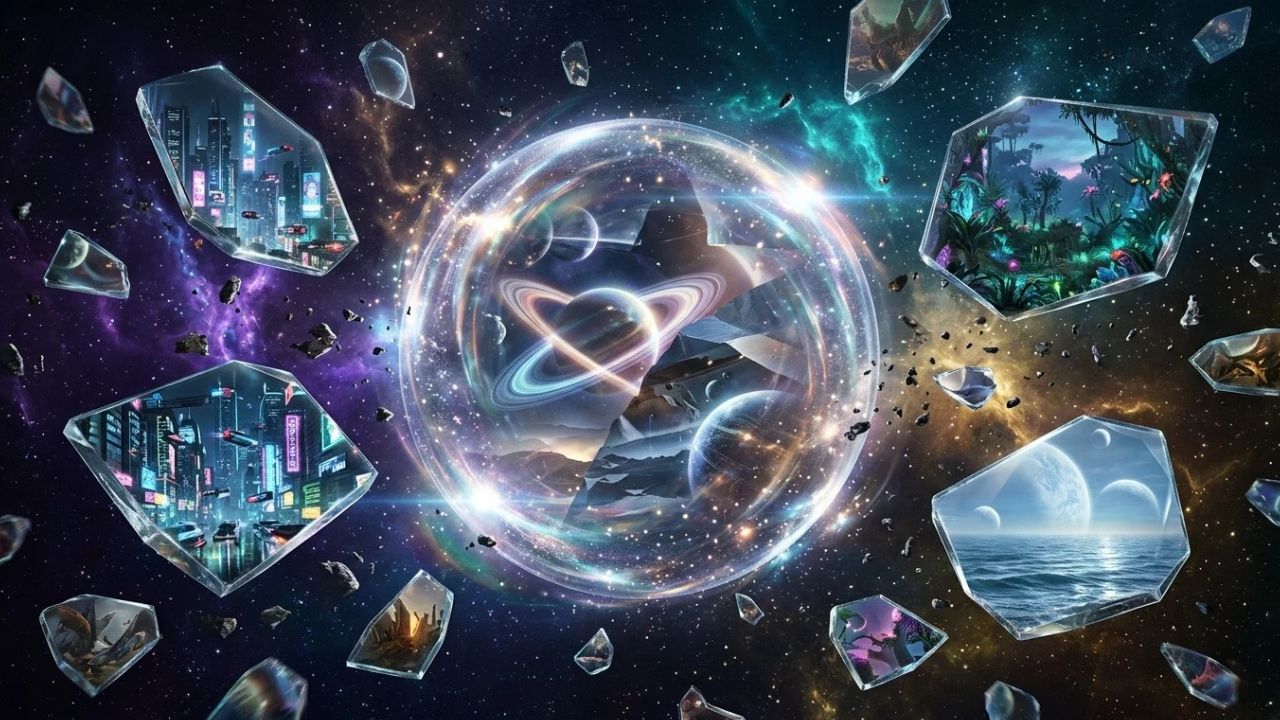
For centuries, humanity looked up at the night sky and wondered if we were alone in the cosmos. Today, theoretical physics has pushed that question past the edge of the observable universe into something infinitely more radical. What if we are not just part of a single universe, but citizens of a sprawling, multidimensional multiverse?
The notion that our reality is merely one bubble in an endless sea of existence has transitioned from pure science fiction into rigorous academic debate. Top physicists, cosmologists, and mathematicians are grappling with data that suggests our physical laws, constants, and history might be localized accidents rather than universal mandates. From quantum mechanics to string theory, modern science reveals a reality far stranger than our ancestors ever dared to dream.
As research funding and technological capabilities scale up, major institutional grants crossing the $10 million threshold are routinely poured into cosmic microwave background analysis and quantum computing simulations, all searching for tangible footprints of alien domains. Let us dive deep into the ten most revolutionary theories reshaping how we understand existence itself.
🌊 1. The Many-Worlds Interpretation: Every Choice Creates a Split 🔬
First proposed by physicist Hugh Everett III in 1957, the Many-Worlds Interpretation (MWI) remains one of the most provocative ideas in quantum mechanics. In standard textbook quantum theory, subatomic particles exist in a superposition of multiple states until observed or measured, at which point the wave function collapses into a single outcome.
Everett turned this premise on its head. He proposed that the wave function never collapses at all. Instead, every single quantum event acts as a branching point. When an electron can spin left or right, the universe literally splits in two. In one reality, the electron spins left; in the other, it spins right, and you split along with it.
This means there is an unfathomable number of alternate Earths where every historical decision, personal choice, and cosmic accident unfolded differently. You might be a billionaire in one reality, a deep-sea explorer in another, or perhaps never born at all in a third. While untestable by conventional means, MWI neatly sidesteps the philosophical paradoxes of quantum measurement and remains heavily defended by prominent theoretical minds.
🫧 2. Cosmic Inflation and the Realm of Eternal Bubbles 🚀
To understand how our universe came to be, cosmologists look to cosmic inflation—the rapid exponential expansion of space in the immediate aftermath of the Big Bang. While inflation stopped in our local patch of space, allowing stars and galaxies to form, theoretical physicist Alan Guth suggested that inflation may never stop globally.
Instead, inflation continues forever in the vast spaces between universes. As space expands at faster-than-light speeds, quantum fluctuations cause pockets of space to stop inflating and undergo their own localized Big Bangs. These pockets form “bubble universes” floating in an infinite inflationary ocean.
Each bubble universe can possess entirely different physical constants, speeds of light, and gravitational strengths. We live inside one peaceful bubble, completely cut off from neighboring bubbles, trapped forever by the cosmic expansion barrier that keeps growing between us.
🪞 3. The Brane Multiverse: Colliding Dimensions in Higher Space 🌌
Rooted in string theory and M-theory, the Brane Multiverse posits that our entire three-dimensional universe is nothing more than a membrane, or “brane,” floating within a higher-dimensional bulk space with four or more spatial dimensions.
According to this framework, our universe could be sitting mere millimeters away from another parallel universe—invisible to us because all light and matter are anchored to our specific brane, unable to leak across the bulk. The only fundamental force that can freely travel between branes is gravity. This startling weakness of gravity compared to electromagnetism could be explained by gravity bleeding out into the surrounding dimensions.
Even more thrilling is the ekpyrotic model: the hypothesis that parallel branes occasionally drift toward each other and collide. Such a cataclysmic impact would not necessarily destroy everything, but rather trigger a fresh Big Bang, resetting the cosmic clock over and over again in an eternal cycle of rebirth.
🧮 4. The Mathematical Universe Hypothesis: Reality is Pure Numbers 📐
Max Tegmark, a cosmologist at the Massachusetts Institute of Technology, takes the concept of parallel universes to its absolute logical extreme. His Mathematical Universe Hypothesis proposes that our physical reality is not just described by mathematics—it is mathematics.
In Tegmark’s view, any mathematical structure that is logically consistent exists physically somewhere outside of human perception. This implies a Level IV multiverse, encompassing every conceivable set of physical laws. If a universe can be described by a distinct set of mathematical equations, it exists just as vividly as our own.
In this cosmic hierarchy, our universe is merely one structural shape among an infinite library of abstract mathematical configurations. It strips away human ego, framing our reality as a single solved equation within a boundless mathematical ocean.
🌀 5. Holographic Universes and Projected Realities 🔮
What if the parallel universes we seek are not hidden away in distant dimensions, but encoded right on the boundary of our own space? The holographic principle, stemming from the study of black holes and string theory, suggests that the three-dimensional volume of space we inhabit is entirely generated by information encoded on a distant, two-dimensional surface.
If space and time are emergent properties rather than fundamental building blocks of reality, the concept of distance breaks down. Parallel universes could exist as alternative software programs running on the same universal boundary code.
Think of it like data files on a hard drive: two completely different virtual worlds can exist side by side on the same storage medium without ever interacting, separated only by the organization of their informational bits.
⏳ 6. Cyclic Universes and the Eternal Return of Time 🔄
Time may not have a definitive beginning or end. Cyclic cosmological models propose that our universe goes through endless loops of expansion, contraction, and rebirth. When a universe reaches maximum entropy and cools down into a cold, dark void, a new contraction or quantum bounce sparks a fresh Big Bang.
Crucially, because quantum fluctuations behave randomly across infinite time, history does not have to repeat itself identically. In the next cycle, stars might form differently, planets may never evolve carbon-based life, or intelligent civilizations might arise with entirely alternate histories.
Each cycle represents a temporal parallel universe existing along the same spatial coordinate, separated not by distance, but by vast chasms of time.
🕳️ 7. Black Hole Baby Universes: Every Singularity is a Genesis 🌌
Could the heart of a black hole hold the doorway to an entirely new cosmos? According to theoretical physics models involving Einstein-Rosen bridges and quantum gravity, when matter collapses inside a black hole, it does not necessarily terminate in an infinite density point.
Instead, it might punch through to the other side, expanding rapidly and inflating into a brand-new “baby universe” disconnected from our own parent space. To an observer inside our universe, matter disappears into a black hole never to return. But from the perspective of the baby universe, that infalling matter represents the primordial material of their entire creation event.
This suggests our own universe could simply be the offspring of a black hole residing in a grander, older multiverse.
🧠 8. Quantum Immortality and Conscious Branching 👁️
Exploring the intersection of quantum mechanics and human consciousness leads to one of the most unsettling hypotheses in modern philosophy: Quantum Immortality. Tied directly to the Many-Worlds Interpretation, this thought experiment suggests that consciousness always follows the timeline where survival is possible.
Imagine a lethal experiment involving a quantum trigger. From an outside perspective, the subject dies half the time. However, from the subjective viewpoint of the conscious observer, their brain only continues to function in the branch where they survive.
While highly controversial and fiercely debated by scientists who argue consciousness cannot be separated from physical degradation, this theory forces us to question whether death is merely a transition into a parallel reality where we continue living.
🗺️ 9. The Infinite Mosaic Universe: Identical Clones Across the Void 🌌
If space is infinite and matter is arranged in finite ways within local Hubble volumes, simple probability dictates that configurations must eventually repeat. Just as shuffling a deck of cards will eventually yield duplicate hands if done enough times, an infinite cosmos must contain exact replicas of our observable patch of space.
Located millions of light-years away across the cosmic dark, there exists a galaxy identical to ours, a solar system matching our sun, an Earth holding duplicate continents, and another you reading these exact words.
While these distant cosmic twins cannot communicate with us due to the speed-of-light limit, they represent spatial parallel universes born out of the sheer statistical weight of infinity.
🔭 10. The Landscape of String Theory: Vacuum States Galore 🧬
String theory requires ten or eleven dimensions of space-time to remain mathematically consistent. To make these equations match our four-dimensional reality, physicists propose that the extra dimensions are curled up into complex, microscopic shapes known as Calabi-Yau manifolds.
The number of ways these dimensions can curl up is staggering—estimated at $10^{500}$ distinct configurations. Each unique configuration creates a distinct vacuum state with its own set of fundamental physical laws, particle masses, and forces.
This creates the “String Landscape,” an immense topological terrain where $10^{500}$ different universes exist as distinct valleys, each governed by its own unique rules of nature.
✨ Conclusion: Standing on the Threshold of Infinity
The exploration of parallel universes challenges our most fundamental assumptions about existence, identity, and destiny. What was once dismissed as pure speculation is now an active frontier of empirical inquiry, driven by advanced particle accelerators, deep-space telescopes, and quantum algorithms.
Whether we eventually find gravitational echoes of a neighboring brane or uncover quantum proof of branching timelines, one thing is certain: reality is far grander, stranger, and more magnificent than we ever imagined. The universe we see is only the tip of an infinite iceberg.