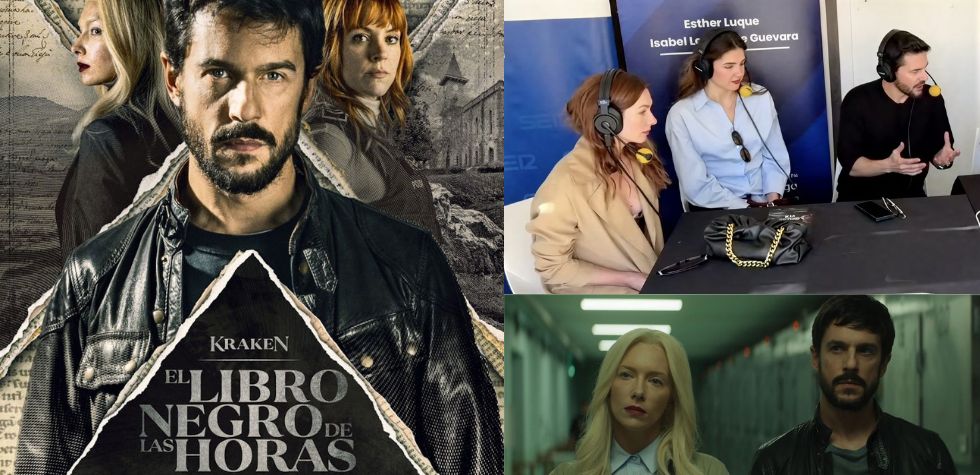
The Malaga Festival hosted the premiere of Kraken: the black book of hoursthe film adaptation of the best seller by Eva García Sáenz de Urturi, one of the most read thriller authors in Spanish. Directed by Manuel Sanabria and Joaquín Llamas, the film transfers the universe of Inspector Kraken to the cinema, in a case that mixes crimes from the past, family secrets and a plot that connects Vitoria with Madrid and also jumps to the 70s. Starring Alejo Sauras and Maggie Civantos, it hits theaters on April 24, after its run in Malaga. We spoke with Alejo Sauras, Aitziber Luma and Natalia Rodríguez. Good afternoon, Alejo, how are you? You are almost a festival classic.
Alejo Sauras: Yes, yes, yes, and with great pride. I am a young veteran. I think I am one of the few who can say that they were at the first edition of the festival, thirty years ago. I was a child, and it was probably with my first short film.
And Aitziber Luma and Natalia Rodríguez also join us. Alejo, we start with you because this film adapts a novel that was a great publishing success in recent years, that many people have read and that continues to be so. In fact, the latest book is about to be published. There is a special pressure when millions of readers already have a very specific image of the story, something common when bringing books to the movies.
Alejo Sauras: Clear. We understand that those of us who dedicate ourselves to this know things that the viewer does not know: they are different languages. Reading is not the same as watching on the screen. Adapting three hundred pages to an hour and fifty minutes of film involves not only changing the language, but also adjusting the times, because not everything fits and what works on paper does not always work in the image. You have to transform elements to make them impact. Many people, mistakenly, go to the cinema expecting to see exactly what they read; If you liked the book so much, read it again. We have looked for an interesting and exciting adaptation for those who experience it instead of reading it.
This thriller combines two times: present and past, with Aitziber traveling between both. What was it like to play with those time jumps and show a different stage from Alejo's? How did you prepare to play a woman from the seventies?
Aitciber Luma: I think it's very interesting. The investigation is explained through the story of my character in the 70s, and the viewer discovers it at the same time as the inspector. It is a very beautiful process. I don't really know how to prepare for something like this: I trusted the directors' vision, their help in creating the character, with a lot of trust and love for the project.
Alejo Sauras: In her case, the arc is long because the character begins as almost a girl and ends as a woman.

The story takes place between Vitoria and Madrid, in the world of bibliophiles and old book geeks, with recognizable spaces and impressive historical exteriors. What was it like filming in those places?
Natalia Rodriguez: Ugh, a total privilege. When I entered the Instituto Cervantes I couldn't believe it. You always see it from the outside and think it's an incredible building, but when you enter and discover its ins and outs, wow! It is a gift and a true privilege to have access.
Alejo Sauras: Let us remember that the Cervantes Institute occupies the old Central Bank, with one of the oldest vaults in Spain. It's beautiful, in a basement full of safe deposit boxes where the rich used to keep their money.
Were there any scenes that were especially complicated due to the dramatic intensity or the demands of the thriller?
Alejo Sauras: Action is always difficult to shoot. There are chases, falls and moments when you know you will get hurt, but you accept it to make it look good. And we think it turned out great, like the chase on Cuesta de Moyano, in Madrid.
Natalia Rodriguez: On a steep slope. Up all the way. And in heels.
Alejo Sauras: That day it was packed with people, like at book fairs: stalls everywhere, books flying, pushing and shoving…
Natalia Rodriguez: I apologize (LAUGHTER).
Alejo Sauras: In addition, we had the extra pressure of a special guest: the author, Eva García Sáenz de Urturi, who came that day and gave us a cameo in the film.

Were you very careful that everything was faithful, saying “this is not like that”?
Alejo Sauras: No, I was very safe and calm. We pestered him with thousands of questions, and he had already answered them all. That day I was relaxed.
The thriller has become one of the strongest genres in Spanish audiovisuals, with an audience that increasingly seeks dark and complex stories, right?
Alejo Sauras: Yes. The whole saga is dark because it tells the story of someone who lives what he doesn't want: he was a police officer and a profiler for the Ertzaintza, but now he teaches classes to young people and doesn't want to return to work. They force him, and above all in a case that concerns him personally, discovering secrets about his own life that he was unaware of. Putting yourself in that person's shoes is very hard.
Will we see the second part?
Aitciber Luma: I hope so.
Alejo Sauras: Hopefully next year we will be here again, chatting about the second part.
Natalia Rodriguez: I have the agenda organized.
Source: https://cineenserio.com/adaptacion-kraken-el-libro-negro-de-las-horas/