
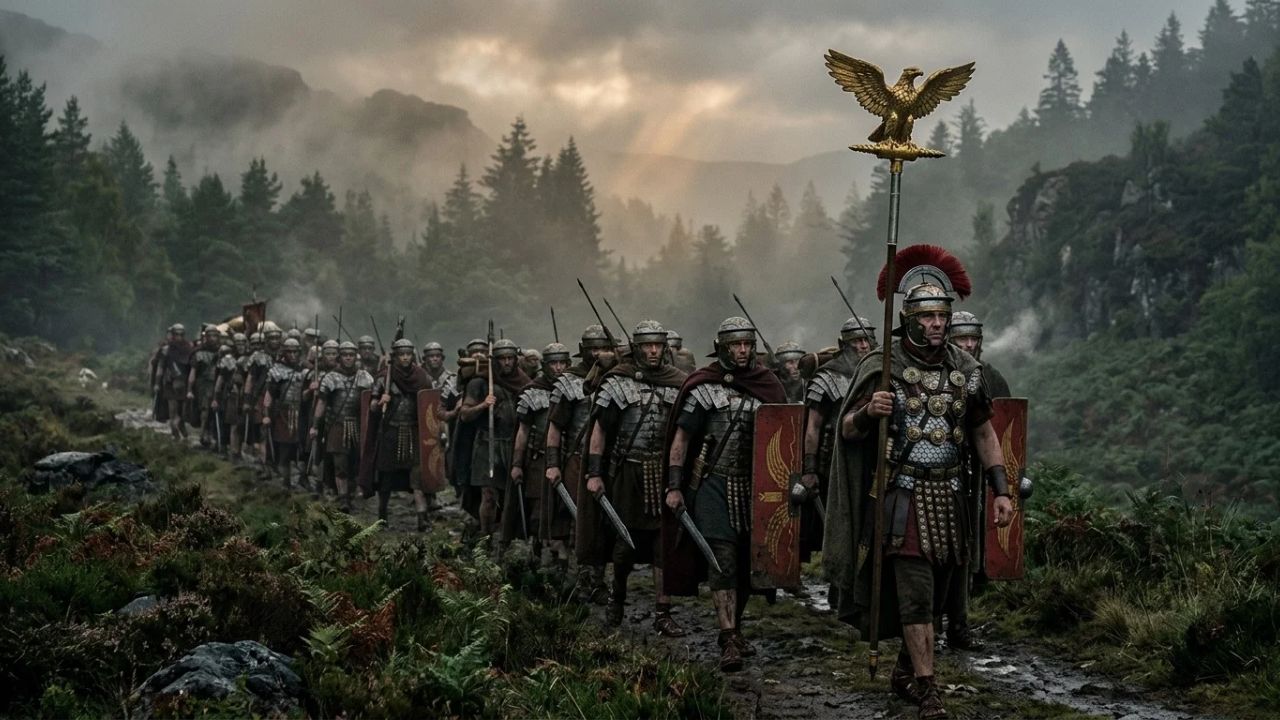
In the annals of military history, few mysteries have captivated scholars and enthusiasts alike as profoundly as the disappearance of the Legio IX Hispana, commonly known as the Ninth Legion. This elite unit of the Roman Imperial Army, renowned for its discipline and battlefield prowess, seemingly vanished from historical records in the early second century AD, leaving behind only fragmented clues and centuries of speculation. What happened to these 5,000 seasoned soldiers who once marched under the golden eagle standard? Did they perish in a catastrophic defeat, or did they fade into obscurity through gradual dissolution? The truth remains one of antiquity’s most enduring enigmas.
The Glory Days of the Ninth Legion ⚔️
The Ninth Legion was established by Julius Caesar around 58 BC during his Gallic Wars, earning its reputation through relentless campaigns across Europe. After supporting Octavian (later Emperor Augustus) in the civil wars that followed Caesar’s assassination, the legion received the honorary title “Hispana” for its distinguished service in the Cantabrian Wars in northern Spain between 25 and 13 BC. This designation reflected not just geographic origin but also the hardened character forged through brutal mountain warfare against fierce Iberian tribes.
By the first century AD, the Ninth Legion had become one of Rome’s most trusted military instruments. Stationed initially in various provinces, it eventually found its permanent home in Britain following the Claudian invasion of 43 AD. The legion played a crucial role in consolidating Roman control over the island, participating in the suppression of Boudica’s revolt in 60-61 AD and later helping to construct Hadrian’s Wall along the northern frontier. Archaeological evidence confirms their presence at numerous forts and settlements throughout England, with inscriptions and artifacts bearing the legion’s distinctive bull emblem discovered from York to Lincoln.
During this period, the Ninth Legion enjoyed considerable prestige and resources. Soldiers received regular pay, land grants upon retirement, and the promise of Roman citizenship for auxiliary troops who served alongside them. The legion’s headquarters at Eboracum (modern-day York) became a thriving military center, complete with bathhouses, temples, and administrative buildings that showcased Roman engineering and organizational superiority. Life for a legionary was harsh but structured, governed by strict discipline and the unshakeable belief in Rome’s eternal dominion.
The Scottish Enigma: Into the Mist 🌫️
The traditional narrative places the Ninth Legion’s demise in Scotland, specifically during Emperor Hadrian’s reign around 120 AD. According to this theory, the legion ventured north beyond Hadrian’s Wall into Caledonia (modern Scotland) to confront hostile Pictish tribes and was annihilated in a devastating ambush. This dramatic scenario gained popular attention through Rosemary Sutcliff’s 1954 novel “The Eagle of the Ninth,” which inspired the 2011 film “The Eagle” starring Channing Tatum.
However, historical evidence for this catastrophic defeat is remarkably thin. No contemporary Roman sources mention such a disaster, which would have been a significant blow to imperial prestige worthy of documentation by historians like Tacitus or Cassius Dio. The Romans meticulously recorded military defeats, particularly those involving entire legions, as seen in accounts of the Teutoburg Forest disaster where three legions were destroyed in 9 AD. The absence of any such record suggests the Ninth Legion’s end was less spectacular than legend implies.
Archaeological investigations in Scotland have yielded mixed results. While Roman military artifacts have been discovered north of Hadrian’s Wall, none can be definitively linked to the Ninth Legion in a context suggesting mass casualties. Some historians argue that the Romans maintained only temporary outposts in Scotland rather than attempting permanent conquest, making a large-scale legionary deployment unlikely. The harsh terrain, hostile population, and logistical challenges of sustaining an army in Caledonia would have made such an expedition extraordinarily risky even for Rome’s formidable military machine.
Alternative Theories: Dissolution and Transfer 📜
Modern scholarship increasingly favors more mundane explanations for the Ninth Legion’s disappearance from British records. One compelling theory suggests the legion was transferred from Britain to the continent around 108-110 AD, possibly to participate in Trajan’s Dacian Wars or subsequent campaigns in the East. Inscriptions found in Nijmegen, Netherlands, indicate the presence of a vexillation (detachment) from the Ninth Legion around 120 AD, suggesting at least part of the unit remained active on the continent.
Another possibility involves gradual dissolution through normal military processes. Roman legions occasionally suffered heavy casualties in smaller engagements, disease outbreaks, or desertion, reducing their effectiveness below operational thresholds. Rather than suffering a single catastrophic defeat, the Ninth Legion may have been incrementally weakened until it was formally disbanded or merged with other units. This process would explain the lack of dramatic historical records while accounting for the legion’s disappearance from British garrison lists.
Some researchers propose that the Ninth Legion was destroyed during the Jewish Revolt of 132-135 AD, though this timeline creates complications given earlier evidence of the legion’s activities. Others suggest involvement in conflicts along the Danube frontier or in North Africa, regions where Rome frequently deployed military forces during the second century. Each theory has supporting evidence and notable gaps, reflecting the fragmentary nature of surviving historical sources from this period.
Archaeological Evidence: Reading the Ruins 🔍
Archaeology has provided crucial insights into the Ninth Legion’s final years, though interpretations remain contested. Excavations at York have revealed continuous occupation through the early second century, with no evidence of sudden destruction or abandonment that would accompany a military catastrophe. Pottery shards, building materials, and personal items suggest normal military life continuing until approximately 120 AD, after which references to the Ninth Legion cease.
Recent discoveries in Scotland have added complexity to the picture. A Roman fort at Inchtuthil, dated to the Flavian period (69-96 AD), shows signs of deliberate dismantling rather than violent destruction. Similarly, sites along the Gask Ridge reveal temporary camps consistent with seasonal campaigning rather than permanent occupation. These findings support theories of limited Roman penetration into Scotland rather than sustained conquest attempts requiring full legionary deployments.
Epigraphic evidence—the study of inscriptions—provides some of the most reliable data. The last confirmed inscription mentioning the Ninth Legion in Britain dates to around 108 AD, found on a building dedication at York. Later inscriptions from the continent reference the legion or its detachments, indicating continued existence beyond Britain. However, these references become increasingly sparse after 120 AD, suggesting the unit’s eventual dissolution or reassignment to other designations.
Cultural Legacy: From History to Hollywood 🎬
Despite scholarly debates, the mystery of the Ninth Legion has captured popular imagination, inspiring numerous works of fiction, films, and documentaries. The romantic notion of lost Roman soldiers battling barbarians in misty Scottish highlands appeals to modern audiences seeking adventure and tragedy in equal measure. This cultural fascination has sometimes overshadowed nuanced historical analysis, creating persistent myths that resist correction through academic research.
The 2011 film “The Eagle” brought renewed attention to the subject, though historians criticized its historical inaccuracies and dramatic liberties. Nevertheless, such productions serve valuable purposes in sparking public interest in ancient history and encouraging further investigation. Museums across Britain feature exhibits on the Ninth Legion, displaying artifacts that bring tangible connection to these vanished soldiers while acknowledging the limits of current knowledge.
Academic conferences continue to debate the legion’s fate, with new archaeological techniques offering fresh perspectives. DNA analysis of skeletal remains, advanced dating methods, and satellite imagery of potential battle sites represent promising avenues for future discovery. Each generation of scholars brings new tools and approaches to this ancient puzzle, gradually refining our understanding even as definitive answers remain elusive.
Conclusion: The Enduring Mystery 🦅
The disappearance of the Ninth Legion exemplifies both the strengths and limitations of historical inquiry. While we possess extensive knowledge about Roman military organization, daily life in provincial garrisons, and imperial strategy, certain events remain obscured by time’s erosion of evidence. The Ninth Legion’s fate may never be conclusively determined, existing instead as a spectrum of probabilities rather than certainties.
What remains undeniable is the legion’s significant contribution to Roman expansion and consolidation of power across Europe. Whether destroyed in battle, dissolved through attrition, or transferred to distant frontiers, these soldiers served the empire faithfully during its zenith. Their story reminds us that history often resists neat narratives, demanding humility from those who seek to reconstruct the past from fragmentary evidence.
As archaeological methods advance and new discoveries emerge, our understanding of the Ninth Legion will undoubtedly evolve. Until then, the mystery persists—a testament to the enduring fascination with Rome’s military might and the human stories hidden within ancient stones. The eagles may have vanished, but their legacy continues to inspire curiosity and wonder across two millennia.