
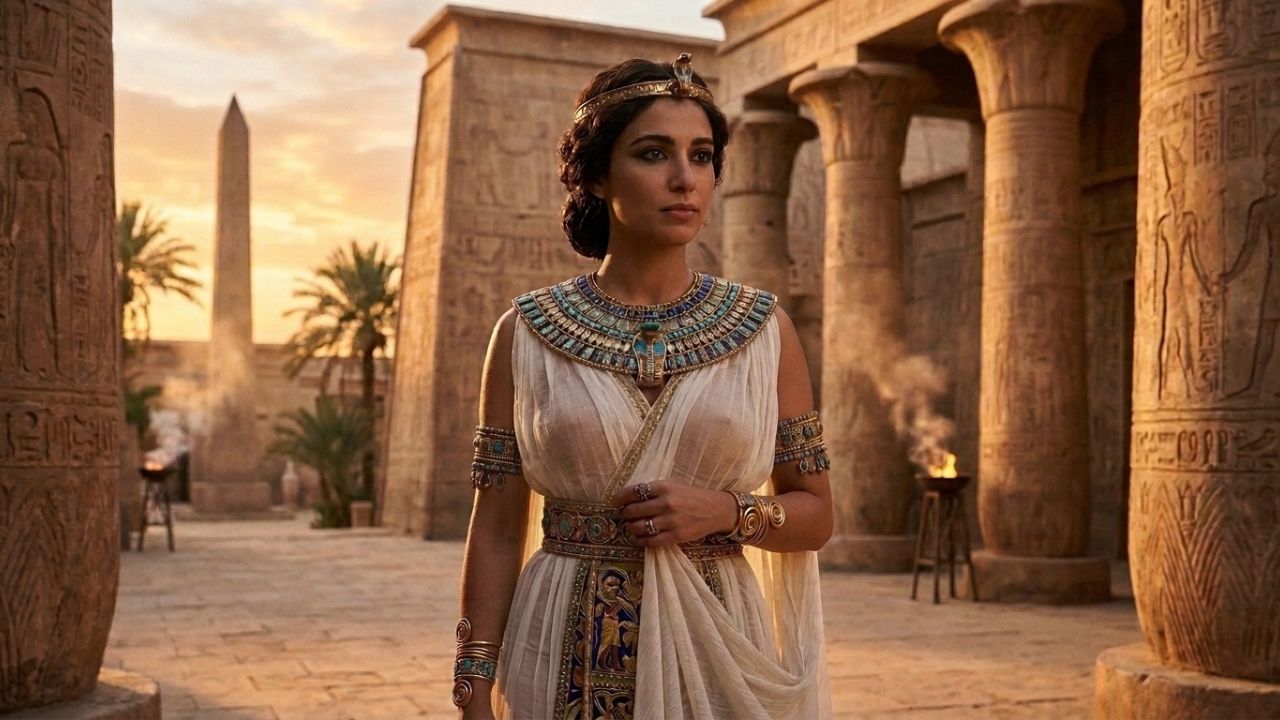
For centuries, popular culture, Hollywood blockbusters, and artistic imaginations have painted Cleopatra VII as the quintessential face of ancient Egyptian beauty, wrapped in linen gowns and kohl-lined eyes by the banks of the Nile. Yet, historical reality tells a drastically different story. Despite ruling over Egypt as its final active monarch, Cleopatra was not ethnically Egyptian. Her true lineage traces back not to the builders of the great pyramids, but to the battlefields of Macedonia and the elite courts of Greece. Unraveling her true heritage requires looking past geographical borders and diving deep into the intricate tapestry of the Hellenistic world.
🏛️ The Macedonian Roots of the Ptolemaic Dynasty
To understand Cleopatra, one must look back to the death of Alexander the Great in 323 BC. When the iconic conqueror died without a clear heir, his vast empire was carved up among his trusted generals. Egypt fell to Ptolemy, son of Lagos, a Macedonian Greek general. Ptolemy established a dynasty that would govern the Nile valley for nearly three hundred years.
Far from blending into the local population or intermarrying with native Egyptians, the Ptolemaic rulers maintained a strict policy of cultural and biological segregation. They considered themselves proud Greeks, preserving their language, traditions, and political systems within the administrative capital of Alexandria. Alexandria was designed as a Greek polis on foreign soil, complete with its own institutions, gymnasiums, and theaters. For nearly three centuries, the royal court operated entirely in Greek, viewing the indigenous Egyptian populace through the lens of colonial administrators.
🧬 The Mathematics of Royal Inbreeding
Genealogy in the Ptolemaic family tree further solidified their non-Egyptian biological profile. To keep royal blood pure and consolidate power, the Ptolemies frequently practiced sibling or close relative marriage, mirroring the divine pairings of ancient Greek mythology.
When tracing Cleopatra’s lineage backward through generations of cousins, uncles, and siblings marrying one another, her ancestry remains overwhelmingly Macedonian Greek. While the exact identity of her mother remains a minor subject of historical debate among scholars, the dominant consensus confirms that her genetic makeup was rooted in Southeastern Europe. To call Cleopatra Egyptian by blood is akin to describing a British colonial governor’s descendant born in India as indigenous South Asian. Her throne was firmly rooted in Egypt, but her bloodline was deeply European.
🗣️ A Linguistic Masterstroke in a Foreign Land
Language serves as one of the most fascinating indicators of Cleopatra’s true cultural orientation. Greek was her mother tongue, the language spoken inside the royal palace, written in official decrees, and utilized among the intellectual elite of Alexandria. For generations, preceding Ptolemaic rulers never bothered to learn the native tongue of their subjects, creating a profound cultural disconnect between the rulers and the ruled.
Cleopatra, however, recognized the immense political utility of bridging that chasm. Historical accounts note that she was a linguistic genius, reportedly mastering nearly nine languages. Crucially, she became the very first ruler in the entire 300-year history of the Ptolemaic dynasty to actually learn and speak the Egyptian language. This was not a nostalgic return to her ancestral roots, but a calculated political masterstroke. By speaking to Egyptian priests and commoners in their native tongue, she legitimized her reign, neutralized domestic unrest, and cast herself as the living incarnation of the goddess Isis.
🎭 Dual Identities: Greek Queen and Egyptian Goddess
Cleopatra’s true genius lay in her masterful navigation of two entirely separate worlds. To the Roman Republic and the Greek-speaking elite of the Mediterranean, she projected the image of a sophisticated Hellenistic monarch, educated in philosophy, rhetoric, and classical arts. She wore the royal diadem of the Greek successors and engaged in high-stakes geopolitics with Roman heavyweights like Julius Caesar and Mark Antony.
Simultaneously, when interacting with the native population and religious institutions of Egypt, she embraced local customs, patronized temples, and participated in sacred rituals dressed in traditional pharaonic regalia. This intentional code-switching allowed her to maintain absolute control over a diverse empire. She was simultaneously a Greek queen governing a Mediterranean kingdom and an Egyptian goddess fulfilling ancient prophecies.
🌍 Rewriting History for Modern Audiences
The persistent myth that Cleopatra was ethnically Egyptian highlights humanity’s tendency to conflate geography with identity. Modern media often flattens ancient complexities into digestible tropes, transforming a sophisticated Macedonian Greek queen into a localized cultural symbol.
Recognizing that Cleopatra was not ethnically Egyptian does not diminish her legacy; rather, it elevates it. Her ability to rule a foreign nation, command its economy, charm the most powerful men of Rome, and respect a culture entirely different from her own showcases a level of political acumen matched by very few figures in world history. Cleopatra remains endlessly fascinating precisely because she stood at the turbulent intersection of multiple worlds, mastering them all before the final curtain fell on the Hellenistic age.