
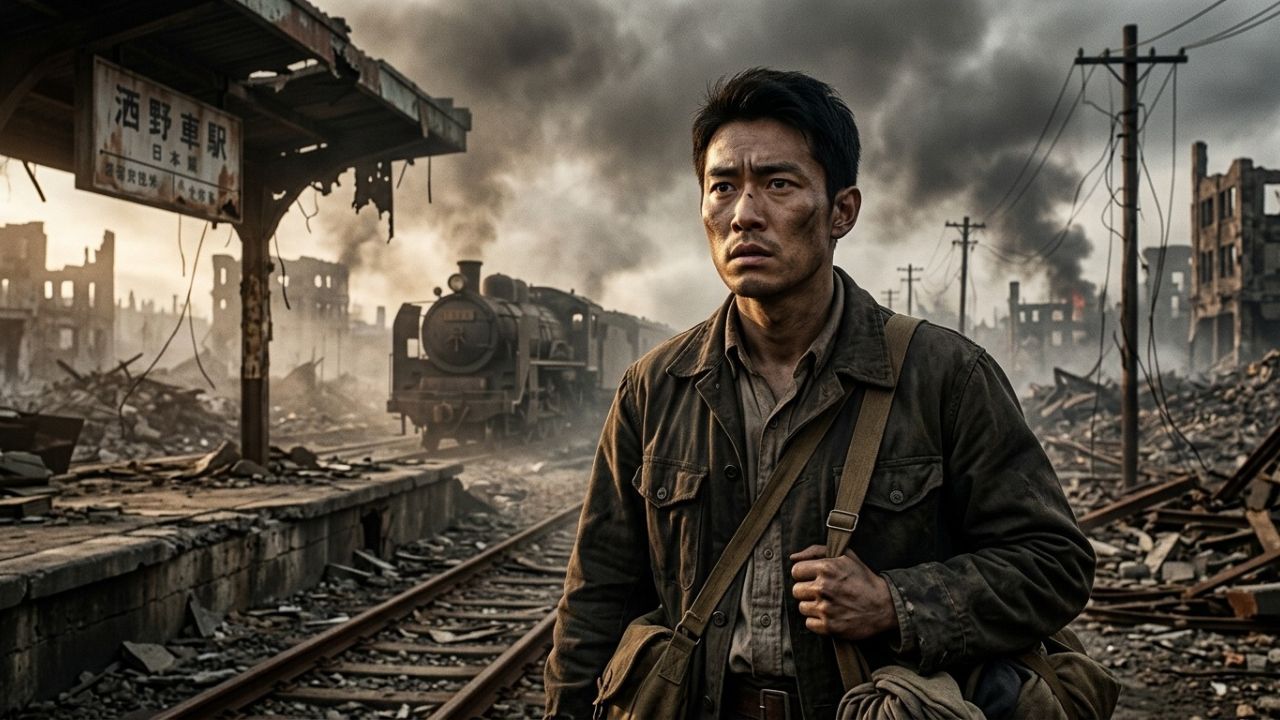
On August 6, 1945, the course of human history changed forever when the United States dropped an atomic bomb on the Japanese city of Hiroshima. Three days later, a second nuclear weapon destroyed Nagasaki. Hundreds of thousands of lives were extinguished in blinding flashes of light and searing heat. Amidst the unspeakable devastation and chaos, one man achieved an almost unimaginable feat: he was present at ground zero in both cities, survived both nuclear blasts, and lived to tell his story to the world. His name was Tsutomu Yamaguchi.
💼 A Routine Business Trip Turns into Nightmare
In the summer of 1945, Tsutomu Yamaguchi was a 29-year-old naval engineer working for Mitsubishi Heavy Industries. A dedicated professional and family man, Yamaguchi had spent three long months away from his home in Nagasaki, working extended hours in Hiroshima. He was part of a specialized design team overseeing the construction of a new oil tanker for the Japanese imperial fleet.
By August 5, the project was finally wrapped up. Yamaguchi and two of his close colleagues, Akira Iwanaga and Kuniyoshi Sato, celebrated the completion of their assignment. They prepared to return home to their families in Nagasaki the following day.
On the morning of August 6, 1945, Yamaguchi packed his bags and set off toward the Hiroshima train station. On his way, he realized he had left his hanko (a traditional personal identification stamp used for signing official documents) at the office. Leaving his colleagues behind at the station, Yamaguchi walked back to the shipyards to retrieve it.
At approximately 8:15 AM, as Yamaguchi walked alongside the docks roughly 3 kilometers (under two miles) from the city center, a low hum vibrated through the summer sky. Looking up, he spotted an American B-29 bomber, the Enola Gay, soaring high above the city. Seconds later, a small object detached from the plane.
What followed was not an ordinary explosion, but a sudden, terrifying transformation of reality. Yamaguchi would later describe it as a flash of blinding, bluish-white light that resembled a gigantic magnesium flare, followed immediately by a deafening shockwave that leveled structures for miles around.
⚡ The Inferno at Hiroshima
The atomic bomb, nicknamed “Little Boy,” detonated at an altitude of roughly 1,900 feet above Hiroshima. The temperature at ground zero reached thousands of degrees Celsius, instantly vaporizing thousands of human beings and turning brick and mortar into ash.
Yamaguchi was blown off his feet by the sheer force of the atomic pressure wave. The explosion ruptured his left eardrum, blinded him temporarily, and inflicted severe thermal burns across the left side of his upper body and neck. Diving into an irrigation ditch beside the road, he pulled his hands over his eyes and ears as the concussive blast ripped through the landscape, tearing away trees and buildings.
When Yamaguchi managed to stand up, the morning daylight had been swallowed whole by a dense, suffocating cloud of dust, smoke, and burning debris. Overhead, a towering mushroom cloud expanded into the upper atmosphere. Walking through the wreckage toward the ruins of the shipyard, Yamaguchi found his two colleagues, who had also miraculously survived the blast with minor injuries.
The three men spent a grueling night inside an air-raid shelter near the destroyed docks. Fires raged uncontrollably across the ruins of Hiroshima. Thousands of severely burned, frantic survivors staggered through the streets, crying out for water that was rapidly becoming contaminated by radioactive fallout.
Despite his agonizing burns, ruptured eardrum, and physical exhaustion, Yamaguchi knew he had to leave the dead city behind. On August 7, he joined a desperate stream of refugees navigating broken wreckage, twisted railway lines, and rivers choked with debris. Managing to cross a burned railway bridge, Yamaguchi and his companions boarded one of the few surviving trains out of the area. The train was heading southwest, carrying the wounded away from the nightmare toward Nagasaki.
🚂 Returning Home to Nagasaki
Yamaguchi arrived in Nagasaki early on the morning of August 8. He staggered through the front door of his home, battered, wrapped in heavy bandages, and visibly suffering from radiation exposure. His wife, Hisako, and their infant son, Katsutoshi, were horrified by his physical condition.
Rather than resting, Yamaguchi insisted on seeking medical assistance at a local clinic. A former classmate treated his burns as best he could, but medical supplies were almost nonexistent. Despite running a high fever and suffering from intense pain, Yamaguchi felt a strong sense of professional obligation.
On the morning of August 9, 1945, Yamaguchi reported to work at the Mitsubishi headquarters in Nagasaki. His colleagues gathered around his desk, staring in disbelief at his heavily bandaged body. At approximately 11:00 AM, Yamaguchi was in the middle of describing the catastrophe in Hiroshima to his corporate supervisor.
His director was skeptical, insisting that a single bomb could not possibly destroy an entire metropolitan city. “You are an engineer,” the director told him. “Calculate it properly. How could one bomb destroy a city like Hiroshima?”
At that exact moment, at 11:02 AM, a blinding white light filled the room.
💥 Lightning Strikes Twice
Roughly 3 kilometers away, the American B-29 bomber Bockscar had dropped “Fat Man,” a plutonium-based atomic bomb even more powerful than the weapon used on Hiroshima. The bomb detonated directly over the Urakami Valley in Nagasaki.
The blast shattered the office building’s reinforced glass, blowing away walls and send heavy debris flying across the room. Yamaguchi was knocked to the floor, once again engulfed by the familiar, terrifying flash and shockwave. His bandages blew off, and his burns were reopened by the force of the blast.
By another incredible stroke of luck, the natural topography of Nagasaki and the structural layout of the Mitsubishi office building absorbed a significant portion of the primary shockwave. While the surrounding area was reduced to scorched ruins, Yamaguchi and his immediate co-workers survived the immediate detonation.
Climbing out of the debris, Yamaguchi ran through the smoke to check on his family. As he approached his neighborhood, he found it completely flattened. Terrified that his wife and young son had perished in the blast, he searched through the rubble in panic. To his immense relief, he found them alive. Hisako had taken their son out to find burn ointment for Yamaguchi’s injuries from Hiroshima; when the bomb exploded, they had taken refuge in a nearby trench, escaping direct exposure to the thermal blast.
In the span of just 72 hours, Tsutomu Yamaguchi had stood near the epicenter of both nuclear detonations in human history and lived.
📜 The Long Battle with Radiation and Recognition
In the days, weeks, and years following the end of World War II, the physical toll of double nuclear exposure became painfully clear. Yamaguchi suffered severely from acute radiation sickness. His hair fell out entirely, his wounds became infected, and he experienced continuous vomiting and high fevers for months. For a long period, his condition was so precarious that his family feared he would not survive the year.
Over time, Yamaguchi slowly regained his strength, though he carried permanent physical scars. His left ear remained permanently deaf, and he suffered from lifelong health complications related to radiation, as did many other survivors known in Japan as Hibakusha (explosion-affected people).
For decades, the Japanese government officially recognized individuals who were present in either Hiroshima or Nagasaki during the bombings. While thousands of people were known to have traveled between the two cities around the time of the attacks, the government was reluctant to officially register individuals as double survivors due to bureaucratic complexity and strict certification guidelines.
Yamaguchi did not press the issue for much of his adult life. He worked as a translator for the U.S. forces during the post-war occupation, later taught school, and eventually returned to his career as an engineer at Mitsubishi.
It was not until he reached his late 80s that Yamaguchi decided to actively pursue official dual recognition, driven by a desire to leave an accurate historical record for future generations. On March 24, 2009, the Japanese government officially certified Tsutomu Yamaguchi as a Nijū Hibakusha (double atomic bomb survivor), making him the first and only person formally recognized by the Japanese state as having survived ground zero in both Hiroshima and Nagasaki.
🕊️ A Voice for Peace and Legacy
In the final years of his life, Yamaguchi transformed his incredible personal survival story into a crusade for global peace and nuclear disarmament. He wrote memoirs, composed traditional Japanese poetry about his experiences, and spoke passionately to international audiences.
In 2006, at the age of 90, Yamaguchi traveled to New York City to address the United Nations General Assembly. Standing before world leaders, he delivered a moving plea for the complete elimination of nuclear weapons:
“Having experienced the atomic bombing twice and survived, it is my destiny to talk about it.”
Yamaguchi also met with filmmaker James Cameron and other cultural figures, hoping to ensure that the human reality of nuclear war would never be forgotten by future generations. He maintained that the true lesson of his life was not merely survival, but the imperative that such weapons must never be used again under any circumstances.
Tsutomu Yamaguchi passed away on January 4, 2010, in Nagasaki at the age of 93, after a battle with stomach cancer. His legacy endures as a testament to human resilience and a timeless warning about the destructive capacity of nuclear armaments.